In the context of corporate blogging, somebody was asking - Blogs just provide opinions, so why the big fuss…why read them? That is like questioning the value that people bring to the table! At the end of the day, Corporates run not just on hi-fi statistical surveys and studies but on opinions as well.
If the subject of discussion is ‘general’ internet blogs by people just wanting to rant and rave about nothing in particular…I don’t know if they’ll help in anyway. (But there are some internet blogs where one gets a lot of the material that one wants on a given topic)
But coming to the corporate scenario, blogs can make a huge difference even if they are not technical in nature. For example, if it is a team-member’s blog, the reader willing, the extent to which one can understand the blogger can be amazing. The catch is that the blogger ought to be honest and forthcoming. Trust, which is the foundation on which relationships are built – both professional as well as personal – is something that blogs can help create. Blogs can reveal the filters that the blogger wears while he looks at the world and can therefore bring out his original intentions – once again, provided the blogger is honest and forthcoming. Assuming that each of us is a good human being and most often than not, relationships go sour due to misunderstandings is where I come from. If the blog is a technical one and if you trust the blogger in some way or the other, it saves you the time that it takes people to run through varied sources of information and then form a vetted opinion. If you trust the blogger(s),that is.
Monday, September 26, 2005


An eye for talent...
I think the task of identifying children that have a lot of potential but don’t have the resources to carve out a career for themselves and giving them the means (education, training) they deserve is a very honourable and laudable mission. It would give one the joy that comes with identifying a diamond in the dustbin and bringing it to a place it deserves. How do some people identify the children that have the potential? I am always fascinated by people (gurus) that identify potential prodigies by taking one look at them. Isn’t that a rare gift! Be it in the movies (directors identify potential superstars), cricket (coaches identify master batsmen), business (CEOs identify their successors), music (maestros identify future composers and singers), religion (religious leaders identify their successors – e.g: Dalai Lama, Pope, Mahant etc) et al. I know of some people who were identified this way – they are the lucky ones – unlike many people who had the potential but weren’t recognized for it by anyone and either had to struggle their way up or go for it single-handedly and create their own empire or, sadly, finally give up in frustration. Rajnikanth is a case in point. He had nothing tangible to prove he would click, but it was K.B (Balachandar) who saw the spark in him. Do you know of any such interesting stories?
Business Strategies...from HBS
There was a seminar on business strategy by a professor from HBS, a few weeks ago, in my organization. It was a busy week but I decided to attend the seminar as it is not often that you get to listen to people from one of the best business schools in the world. Let’s refer to the professor as Prof. DU for I don’t fully understand the implications of referring to his real name on my blog and especially so in the context of discussing my interpretations of the ‘class’ at length. Before I go on to share with you what I learned and what the food for thought that I am still chewing on is, I want to place in front of you an observation that I’ve made. In many a session that I’ve been to, the speaker seems to miss the ‘target’ by miles. It is indeed a disappointing thing for people who walk into the session only because of the topic and not necessarily for any sort of ‘intellectual break’. That way, the session that I attended was quite off target. The topic announced was “Aligning IT with business strategy in Manufacturing’ and what Prof. DU dwelt upon was a new business strategy model. It had nothing much to do with IT alignment or for that matter the world of manufacturing. (Let me help you get this straight - I personally have nothing to complain about as I enjoyed the session immensely :)) So, what happens in such situations? Is it about communication gaps or about speakers who commit something but decide to get away with discussing something else because they figure out that they are not after all interested in dwelling upon the area under question? Anyways, I want to make it extremely clear that I enjoyed the session for its humor and, of course, for its ideas.
Prof. DU started off by talking about the traditional business strategy model which starts off with the Ends and ends with the means. That is, Ends -> Ways -> Means. Ways refers to business decisions while means refers to the resources to get there. He went on to detail out the traditional business strategy formulation and how it originated from the military way of strategizing. The very word strategy apparently originated from the Greek word strateos, meaning General (as in the army). Prof. DU peppered the session with interesting thoughts and humor and finally proposed that the model be turned on its head….upside down. He asked the audience to consider starting off with the ways…starting off with the capabilities, building it gradually to grab opportunities in the area. (During the session I was sort of completely taken in by excitement and thought it was fun to turn ideas upside down.) So, you start with capabilities, go on to opportunities, and then set your vision. But later, I started considering the idea seriously- from the perspective of implementing it - and ‘am grappling with some thoughts that do not seem to particularly like the idea… What about the concept of setting high-flying visions? What about dreaming? What if it becomes a limiting factor? Wont it be a solution looking for a problem? …Unless you believe in destiny and a certain purpose in life? These are some ambiguities that I did not bother to get it cleared at the time of the session. Meanwhile, the Prof did indicate that he seemed to have a problem with numerical goals (ow, yeah! :-)). He said something which I think is the clear truth to my mind as well – when there are two goals – quantitative and qualitative – the former will always dominate. Well said! Well said! Encore! (The implications? Does this mean that it will be numerical targets all the way in any given organization? I am reminded of an interesting example here – I read in an article that Jeff Immelt is changing the way GE is managed – he is emphasizing on qualitative aspects rather than quantitative….mmmm…well! What would Welch have to say about that?) And….PS: What a coincidence – I came across this quote recently – If a man will begin with certainties, he shall end in doubts; but if he will be content to begin with doubts he shall end in certainties. - Sir Francis Bacon. I leave this to your interpretation.
Prof. DU touched upon some topics that I always ponder over – there is no strategy where there is no long-term ownership! CEOs stay but for 5 or more years. What will they think about true strategy? They are bound to look at short-term gains and move on to greener pastures. Acquisitions take them to the headlines – they make an appearance on page 1 of leading dailies in black/grey suits and become ‘poster boys’. And, that’s what many CEOs want. Reminds me of something I read long back – the true success of a leader is not in what happens while she is at the helm but what happens a few years after she’s left….sustainable systems is the name of the game. So, the suggested idea was that there ought not to be 5-year plans in the corporate world! There was a counter argument from someone in the audience that one can’t see beyond 5 years anyways, so, what could the way out? The answer - that’s why we need to look at rolling forecasts – and remember that we can’t predict everything.
Prof. also spoke about incremental improvements – rather than the big bang approach. Sometimes, he added, both are needed but the alignment was clearly more towards the former.
(There was a little bit of M-bashing, CF-bashing, and I thought, Japan-embracing through the session. )
The Prof also shared with us a very interesting study conducted by HBS on the implications of IS – IT systems implementations. It starts off with a dip in productivity as employees are brought into it from various functions and departments. Then things lead to bug discoveries and eventually the evolution of the system happens, to serve some purposes. Before we realize it, technology and/or requirements will then have changed! It is interesting to see how we take to IT despite the need to evolve so fast when you are on to IT. For example, the mobile phone I have now is way below today’s standard. But it serves my basic purpose and I don’t feel the need to splurge on one of today’s gizmos though the temptation is quite strong. Anyways, the HBS research was a nice one, I thought. And another thing - Prof. DU called IT systems ‘liquid concrete’ – hmmm, interesting description!
Another interesting comparison that was discussed was that between qualitative and quantitative approaches to business –
Reduction in costs – qualitative does not work, quantitative does
Revenue generation – only qualitative approaches works
Options in business - value generation – innovation - only qualitative approaches work
Methinks when entrepreneurs start off, they actually start qualitative – based on their passions - and then get converted into quantitatively-oriented people somewhere down the line.
Some other interesting thoughts that came through to me were:
- The basic idea of turning the business strategy method on its head – it reminded me of paradoxical approaches.
- Another aspect that was brought out was that of the network effect and its role in strategy. Forecasts may not work, may be way away from reality as they do not and perhaps cannot consider all human factors that bring about something like the network effect. So, why forecast at all? :)
Whew! Forgive me for this extremely long-winding and convoluted deliberation…but it has led me to a little bit of re-organization; my own contribution; nothing but another alternative that we are bound to have with three parameters – vision, ways and means. Why not start with opportunities and move on to the ways and then the vision??? That means nothing but being street-smart and getting the moolah quickly. What?
Prof. DU started off by talking about the traditional business strategy model which starts off with the Ends and ends with the means. That is, Ends -> Ways -> Means. Ways refers to business decisions while means refers to the resources to get there. He went on to detail out the traditional business strategy formulation and how it originated from the military way of strategizing. The very word strategy apparently originated from the Greek word strateos, meaning General (as in the army). Prof. DU peppered the session with interesting thoughts and humor and finally proposed that the model be turned on its head….upside down. He asked the audience to consider starting off with the ways…starting off with the capabilities, building it gradually to grab opportunities in the area. (During the session I was sort of completely taken in by excitement and thought it was fun to turn ideas upside down.) So, you start with capabilities, go on to opportunities, and then set your vision. But later, I started considering the idea seriously- from the perspective of implementing it - and ‘am grappling with some thoughts that do not seem to particularly like the idea… What about the concept of setting high-flying visions? What about dreaming? What if it becomes a limiting factor? Wont it be a solution looking for a problem? …Unless you believe in destiny and a certain purpose in life? These are some ambiguities that I did not bother to get it cleared at the time of the session. Meanwhile, the Prof did indicate that he seemed to have a problem with numerical goals (ow, yeah! :-)). He said something which I think is the clear truth to my mind as well – when there are two goals – quantitative and qualitative – the former will always dominate. Well said! Well said! Encore! (The implications? Does this mean that it will be numerical targets all the way in any given organization? I am reminded of an interesting example here – I read in an article that Jeff Immelt is changing the way GE is managed – he is emphasizing on qualitative aspects rather than quantitative….mmmm…well! What would Welch have to say about that?) And….PS: What a coincidence – I came across this quote recently – If a man will begin with certainties, he shall end in doubts; but if he will be content to begin with doubts he shall end in certainties. - Sir Francis Bacon. I leave this to your interpretation.
Prof. DU touched upon some topics that I always ponder over – there is no strategy where there is no long-term ownership! CEOs stay but for 5 or more years. What will they think about true strategy? They are bound to look at short-term gains and move on to greener pastures. Acquisitions take them to the headlines – they make an appearance on page 1 of leading dailies in black/grey suits and become ‘poster boys’. And, that’s what many CEOs want. Reminds me of something I read long back – the true success of a leader is not in what happens while she is at the helm but what happens a few years after she’s left….sustainable systems is the name of the game. So, the suggested idea was that there ought not to be 5-year plans in the corporate world! There was a counter argument from someone in the audience that one can’t see beyond 5 years anyways, so, what could the way out? The answer - that’s why we need to look at rolling forecasts – and remember that we can’t predict everything.
Prof. also spoke about incremental improvements – rather than the big bang approach. Sometimes, he added, both are needed but the alignment was clearly more towards the former.
(There was a little bit of M-bashing, CF-bashing, and I thought, Japan-embracing through the session. )
The Prof also shared with us a very interesting study conducted by HBS on the implications of IS – IT systems implementations. It starts off with a dip in productivity as employees are brought into it from various functions and departments. Then things lead to bug discoveries and eventually the evolution of the system happens, to serve some purposes. Before we realize it, technology and/or requirements will then have changed! It is interesting to see how we take to IT despite the need to evolve so fast when you are on to IT. For example, the mobile phone I have now is way below today’s standard. But it serves my basic purpose and I don’t feel the need to splurge on one of today’s gizmos though the temptation is quite strong. Anyways, the HBS research was a nice one, I thought. And another thing - Prof. DU called IT systems ‘liquid concrete’ – hmmm, interesting description!
Another interesting comparison that was discussed was that between qualitative and quantitative approaches to business –
Reduction in costs – qualitative does not work, quantitative does
Revenue generation – only qualitative approaches works
Options in business - value generation – innovation - only qualitative approaches work
Methinks when entrepreneurs start off, they actually start qualitative – based on their passions - and then get converted into quantitatively-oriented people somewhere down the line.
Some other interesting thoughts that came through to me were:
- The basic idea of turning the business strategy method on its head – it reminded me of paradoxical approaches.
- Another aspect that was brought out was that of the network effect and its role in strategy. Forecasts may not work, may be way away from reality as they do not and perhaps cannot consider all human factors that bring about something like the network effect. So, why forecast at all? :)
Whew! Forgive me for this extremely long-winding and convoluted deliberation…but it has led me to a little bit of re-organization; my own contribution; nothing but another alternative that we are bound to have with three parameters – vision, ways and means. Why not start with opportunities and move on to the ways and then the vision??? That means nothing but being street-smart and getting the moolah quickly. What?
Thursday, September 22, 2005
One day in the Year of the Ox - Opinion - Express Computer India
Good review of the HBR article "IT Doesn't Matter".
My immediate take - IT is but the cloth that envelopes the body-the organization. It will either take the shape of the organization if flexible enough or force the organization into its own shape thus leaving it gasping for breath or loose and floating. It per se will never be a competitive advantage except speeden up processes and improve efficiency. It will certainly force reviews of business processes if the product under question is an evolved one. To what extent it is tailored matters a lot. An organization that invests the intellectual capital, money and time in the customization exercise will deliver and gain a lot. The way an organization puts IT to use can give it an advantage, and IT cannot be replicated easily and quickly unless and until all organizations are using IT as it is....
My immediate take - IT is but the cloth that envelopes the body-the organization. It will either take the shape of the organization if flexible enough or force the organization into its own shape thus leaving it gasping for breath or loose and floating. It per se will never be a competitive advantage except speeden up processes and improve efficiency. It will certainly force reviews of business processes if the product under question is an evolved one. To what extent it is tailored matters a lot. An organization that invests the intellectual capital, money and time in the customization exercise will deliver and gain a lot. The way an organization puts IT to use can give it an advantage, and IT cannot be replicated easily and quickly unless and until all organizations are using IT as it is....
Tuesday, September 20, 2005
Time O Time
For a few weeks now, I’ve been feeling a little under pressure due to the sheer number of things I am into. I strongly suspect that the feeling has accentuated after I got into blogging and blog-surfing. Blogging actually happens without any effort most of the time as I write on the fly or spend some extra time during the weekends to write up some of my lengthier essays. At times, I do end up spending 1 hour on some of my posts, but I think it is more than worth it. But it is blog-surfing that has presented to me the enormity of the challenge I am trying to tackle. Reading almost 100 blogs on a weekly basis, leave alone on a daily basis, is not a joke. This, despite RSS subscriptions. I have been concentrating on work and a couple of other things and have not read many of the blogs that I’ve bookmarked, for 3 weeks now. Not to forget, the deluge of informative emails that one gets. Email is like a never-drying ocean of information. Anyways, I decided to put pen to paper and come up with a mind map of things I am into. Next, for a lowdown on time-management, I approached an expert and asked her for suggestions on what I could do to make my life less of a clutter. I am already feeling slightly better. Hopefully, as I start working on her suggestions in this new situation of improved awareness, things will look less formidable. Here are the ideas I’ll be working on:
- a daily/weekly/monthly timetable/planner that takes into consideration everything I want to do
- a clear demarcation between what’s urgent and what’s important and getting rid of the urgent and unavoidable things. understanding the implications of not doing or doing each task and prioritizing based on desired outcomes
- setting aside one day a week (that’s relatively free) at work (mon thru fri) for catching up with a few non-core-work related tasks (reading business magazines, catching up with business material on the net etc)
- look up mintools.com for ideas and tools
- read and use Steven Covey’s book and planning tools respectively
- using the 80:20 rule to understand what those critical 20% tasks are that make up my life
- maintain a daily time log to note where my time’s ‘going’ and act on it if it is undesirable
- ask myself what I really want to do and prioritize based on that
Here’s the mind map I drew.
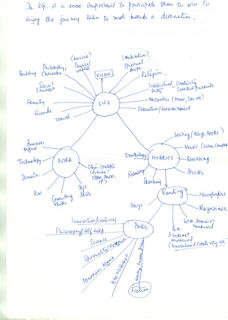
There is an interesting coincidence associated with this exercise of mine. When I began drawing this map, I saw a coffee cup in front of me and the cup had this etched on it – “In life, it is more important to participate than to win. To enjoy the journey than to rush towards a destination”. Well, that will be the guiding light in this endeavour of mine. We can’t forget the pleasures of life (read: journey). We can't always look at the ends and forget the means. Can we?
- a daily/weekly/monthly timetable/planner that takes into consideration everything I want to do
- a clear demarcation between what’s urgent and what’s important and getting rid of the urgent and unavoidable things. understanding the implications of not doing or doing each task and prioritizing based on desired outcomes
- setting aside one day a week (that’s relatively free) at work (mon thru fri) for catching up with a few non-core-work related tasks (reading business magazines, catching up with business material on the net etc)
- look up mintools.com for ideas and tools
- read and use Steven Covey’s book and planning tools respectively
- using the 80:20 rule to understand what those critical 20% tasks are that make up my life
- maintain a daily time log to note where my time’s ‘going’ and act on it if it is undesirable
- ask myself what I really want to do and prioritize based on that
Here’s the mind map I drew.
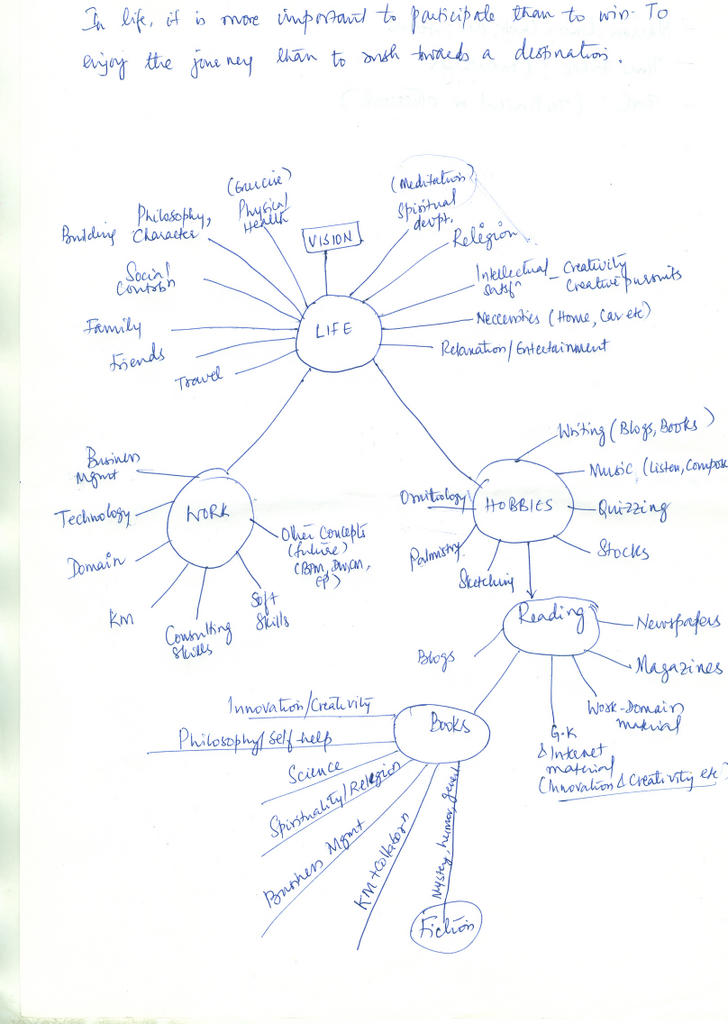
There is an interesting coincidence associated with this exercise of mine. When I began drawing this map, I saw a coffee cup in front of me and the cup had this etched on it – “In life, it is more important to participate than to win. To enjoy the journey than to rush towards a destination”. Well, that will be the guiding light in this endeavour of mine. We can’t forget the pleasures of life (read: journey). We can't always look at the ends and forget the means. Can we?
Monday, September 19, 2005
Blogs for Retailers - Passing Thoughts
I have had this thought for some time now – in the case of service-oriented companies such as retailers, blogs by customer-facing employees who make it a point to talk about their good and bad experiences from which the rest of the organization can learn lessons on customer satisfaction and complaints will be truly useful. Ultimately, a well-defined and designed system will even lead to effective business analytics. Such blogs can of course be subscribed to by employees across the organization and smart subscriptions and tags will help filter the more useful of the posts. Looking at these blogs from the other angle, if these blogs are on the public network and are visited by customers and prospect customers who care to leave their comments and thoughts behind, it will make a huge difference, provided the organization is ready to pick up subtle messages and obvious complaints. The network effect as known in the marketing world can also be put to good work here!!!
Wednesday, September 14, 2005
I gotta learn!!!!!!
A Thought for the Day From Sri Eknath Easwaran
----------------------------------------------
September 12
Each day is a little life; every waking and rising a little birth; every fresh morning a little youth; every going to rest and sleep a little death. - Arthur Schopenhauer
My grandmother, my spiritual teacher, used to tell me that the pain we associate with the great change called death arises from our innumerable selfish attachments. One day she illustrated this in a simple way by asking me to sit in a chair and hold tight to the arms. Then she tried to pull me out of the chair. She tugged and pulled at me, and I held on tight.
It was painful. She was a strong person, and even though I held on with all my strength, she pulled me out. Then she told me to sit down again, but this time not to hold on anywhere just to get up and come to her when she called. With ease I got out of the chair and went to her. This, she told me, is how to overcome the fear and pain of death. When we hold onto things -- houses, cars, books, guitars, our antique silver teapot -- we get attached and tied down.
-------------------------------
I need to learn...esp. when it comes to books....I seem to be obsessed with them and will not even allow members of the insectopedia/reptilia family to trespass into the area in which my book shelf is located...let alone homo sapiens
----------------------------------------------
September 12
Each day is a little life; every waking and rising a little birth; every fresh morning a little youth; every going to rest and sleep a little death. - Arthur Schopenhauer
My grandmother, my spiritual teacher, used to tell me that the pain we associate with the great change called death arises from our innumerable selfish attachments. One day she illustrated this in a simple way by asking me to sit in a chair and hold tight to the arms. Then she tried to pull me out of the chair. She tugged and pulled at me, and I held on tight.
It was painful. She was a strong person, and even though I held on with all my strength, she pulled me out. Then she told me to sit down again, but this time not to hold on anywhere just to get up and come to her when she called. With ease I got out of the chair and went to her. This, she told me, is how to overcome the fear and pain of death. When we hold onto things -- houses, cars, books, guitars, our antique silver teapot -- we get attached and tied down.
-------------------------------
I need to learn...esp. when it comes to books....I seem to be obsessed with them and will not even allow members of the insectopedia/reptilia family to trespass into the area in which my book shelf is located...let alone homo sapiens
Whew....
I've got almost 6-7 posts that are waiting to be completed....whew! My days are packed! : Not finding the time to sit down and finish them....life is chugging along but the ideas are getting 'stored' in a word document....so, there's perhaps no worry of losing the train of thoughts...or is there? Mmmmm? :)
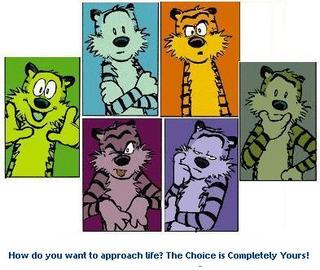
Anyways, here's something (some pictures and a quote) that I had put together last year (and simply loved the final outcome). This one’s just to compensate for the lack of ‘activity’ on my blog; even as I realized that the blog is beginning to look a tad boring without pictures. Good thing I recalled that this one is a great picture to share...what say?
PS: In the next few days, I should be able to hopefully put up a longish article on strategizing and the like, based on a seminar that I attended in office!
UPDATE: The cartoon you see in this post is of course, our lovable, Hobbes...Calvin's pet, best friend and alter ego! The actual context is one where Calvin tries out various goggles and asks Hobbes for his opinion. Hobbes responds with so many different expressions when calvin tries out the goggles... :) I pulled out the various expressions, put them up in one box and thought the quote below (which is my own quote) suits the picture amazingly well. :), Thanks to Bill Watterson for the inspiration! Those who know me also know that I can never stop thanking Bill for the wonderful Calvin n Hobbes stories... :). Thanks to neha for helping me put this post in the right perspective and add this bit to make it a complete one...! :)
Anyways, here's something (some pictures and a quote) that I had put together last year (and simply loved the final outcome). This one’s just to compensate for the lack of ‘activity’ on my blog; even as I realized that the blog is beginning to look a tad boring without pictures. Good thing I recalled that this one is a great picture to share...what say?

PS: In the next few days, I should be able to hopefully put up a longish article on strategizing and the like, based on a seminar that I attended in office!
UPDATE: The cartoon you see in this post is of course, our lovable, Hobbes...Calvin's pet, best friend and alter ego! The actual context is one where Calvin tries out various goggles and asks Hobbes for his opinion. Hobbes responds with so many different expressions when calvin tries out the goggles... :) I pulled out the various expressions, put them up in one box and thought the quote below (which is my own quote) suits the picture amazingly well. :), Thanks to Bill Watterson for the inspiration! Those who know me also know that I can never stop thanking Bill for the wonderful Calvin n Hobbes stories... :). Thanks to neha for helping me put this post in the right perspective and add this bit to make it a complete one...! :)
Tuesday, September 13, 2005
My friend says....The Blog:
Blog(Glob)ing for posers!: "Its the best place to please both your ego and your conscience by giving them a stage to fight :)"
--------
Well said, Sari! :)
--------
Well said, Sari! :)
Monday, September 12, 2005
lessons learned how to build a successful blog
lessons learned how to build a successful blog
A great page to check out what's happening in the world of corporate blogging...
A great page to check out what's happening in the world of corporate blogging...
Leadership - Jim Via Zig
Zig Ziglar Full Newsletter: "The Qualities Of Skillful Leadership
By Jim Rohn
If you want to be a leader who attracts quality people, the key is to become a person of quality yourself. Leadership is the ability to attract someone to the gifts, skills, and opportunities you offer as an owner, as a manager, as a parent. I call leadership the great challenge of life.
What's important in leadership is refining your skills. All great leaders keep working on themselves until they become effective. Here are some specifics:
1. Learn to be strong but not rude. It is an extra step you must take to become a powerful, capable leader with a wide range of reach. Some people mistake rudeness for strength. It's not even a good substitute.
2. Learn to be kind but not weak. We must not mistake kindness for weakness. Kindness isn't weak. Kindness is a certain type of strength. We must be kind enough to tell somebody the truth. We must be kind enough and considerate enough to lay it on the line. We must be kind enough to tell it like it is and not deal in delusion.
3. Learn to be bold but not a bully. It takes boldness to win the day. To build your influence, you've got to walk in front of your group. You've got to be willing to take the first arrow, tackle the first problem, discover the first sign of trouble.
4. You've got to learn to be humble, but not timid. You can't get to the high life by being timid. Some people mistake timidity for humility. Humility is almost a God-like word. A sense of awe. A sense of wonder. An awareness of the human soul and spirit. An understanding that there is something unique about the human drama versus the rest of life. Humility is a grasp of the distance between us and the stars, yet having the feeling that we're part of the stars. So humility is a virtue; but timidity is a disease. Timidity is an affliction. It can be cured, but it is a problem.
5. Be proud but not arrogant. It takes pride to win the day. It takes pride to build your ambition. It takes pride in community. It takes pride in cause, in accomplishment. But the key to becoming a good leader is being proud without being arrogant. In fact, I believe the worst kind of arrogance is arrogance from ignorance. It's when you don't know that you don't know. Now that kind of arrogance is intolerable. If someone is smart and arrogant, we can tolerate that. But if someone is ignorant and arrogant, that's just too much to take.
6. Develop humor without folly. That's important for a leader. In leadership, we learn that it's okay to be witty, but not silly. It's okay to be fun, but not foolish.
7. Lastly, deal in realities. Deal in truth. Save yourself the agony. Just accept life like it is. Life is unique. Some people call it tragic, but I'd like to think it's unique. The whole drama of life is unique. It's fascinating. And I've found that the skills that work well for one leader may not work at all for another. But the fundamental skills of leadership can be adapted to work well for just about everyone: at work, in the community, and at home.
------------------------------------------------
No wonder being a leader is not particulary easy! :-)
By Jim Rohn
If you want to be a leader who attracts quality people, the key is to become a person of quality yourself. Leadership is the ability to attract someone to the gifts, skills, and opportunities you offer as an owner, as a manager, as a parent. I call leadership the great challenge of life.
What's important in leadership is refining your skills. All great leaders keep working on themselves until they become effective. Here are some specifics:
1. Learn to be strong but not rude. It is an extra step you must take to become a powerful, capable leader with a wide range of reach. Some people mistake rudeness for strength. It's not even a good substitute.
2. Learn to be kind but not weak. We must not mistake kindness for weakness. Kindness isn't weak. Kindness is a certain type of strength. We must be kind enough to tell somebody the truth. We must be kind enough and considerate enough to lay it on the line. We must be kind enough to tell it like it is and not deal in delusion.
3. Learn to be bold but not a bully. It takes boldness to win the day. To build your influence, you've got to walk in front of your group. You've got to be willing to take the first arrow, tackle the first problem, discover the first sign of trouble.
4. You've got to learn to be humble, but not timid. You can't get to the high life by being timid. Some people mistake timidity for humility. Humility is almost a God-like word. A sense of awe. A sense of wonder. An awareness of the human soul and spirit. An understanding that there is something unique about the human drama versus the rest of life. Humility is a grasp of the distance between us and the stars, yet having the feeling that we're part of the stars. So humility is a virtue; but timidity is a disease. Timidity is an affliction. It can be cured, but it is a problem.
5. Be proud but not arrogant. It takes pride to win the day. It takes pride to build your ambition. It takes pride in community. It takes pride in cause, in accomplishment. But the key to becoming a good leader is being proud without being arrogant. In fact, I believe the worst kind of arrogance is arrogance from ignorance. It's when you don't know that you don't know. Now that kind of arrogance is intolerable. If someone is smart and arrogant, we can tolerate that. But if someone is ignorant and arrogant, that's just too much to take.
6. Develop humor without folly. That's important for a leader. In leadership, we learn that it's okay to be witty, but not silly. It's okay to be fun, but not foolish.
7. Lastly, deal in realities. Deal in truth. Save yourself the agony. Just accept life like it is. Life is unique. Some people call it tragic, but I'd like to think it's unique. The whole drama of life is unique. It's fascinating. And I've found that the skills that work well for one leader may not work at all for another. But the fundamental skills of leadership can be adapted to work well for just about everyone: at work, in the community, and at home.
------------------------------------------------
No wonder being a leader is not particulary easy! :-)
Some financial advice for women...
Moneycontrol.com - News, 9 money tips for a smart woman - TAX, Personal Finance, Money, Income Tax, mutual funds, insurance, debt, loans
Pretty obvious....but the obvious as they say is often overlooked...
Pretty obvious....but the obvious as they say is often overlooked...
Nice stuff from Eknath!
A Thought for the Day From Sri Eknath Easwaran
----------------------------------------------
Even as a tortoise draws in its limbs, the wise can draw in their senses at will. - Bhagavad Gita
The Gita says a free person can draw in his senses just as a tortoise draws in its legs. What a marvelous simile! Just imagine a tortoise being approached by a group of school children with sticks in their hands. He sees the children coming, and the command is given to the limbs, "Retire!"
Immediately, the head, the tail, and the four legs withdraw into the shell. The children come; they beat out a rhythm on the shell with their sticks. They toss the tortoise in the air, but they can't harm him. After the children leave and all is quiet, the tortoise ventures to stick his neck out, then his tail and legs. He continues his journey, unconcerned. He goes where he likes.
If we want to live in freedom, Krishna says, we must train our senses. We learn when to welcome an experience, and when to withdraw for our own safety. We become masters of our lives. Then we will be like the giant tortoise I saw at the zoo - wandering freely while all the other animals were in cages. A notice on his back read: "I am free. Don't report me to the management."
---------------------------
:-) Lots to learn from all the living beings that we co-exist with!
----------------------------------------------
Even as a tortoise draws in its limbs, the wise can draw in their senses at will. - Bhagavad Gita
The Gita says a free person can draw in his senses just as a tortoise draws in its legs. What a marvelous simile! Just imagine a tortoise being approached by a group of school children with sticks in their hands. He sees the children coming, and the command is given to the limbs, "Retire!"
Immediately, the head, the tail, and the four legs withdraw into the shell. The children come; they beat out a rhythm on the shell with their sticks. They toss the tortoise in the air, but they can't harm him. After the children leave and all is quiet, the tortoise ventures to stick his neck out, then his tail and legs. He continues his journey, unconcerned. He goes where he likes.
If we want to live in freedom, Krishna says, we must train our senses. We learn when to welcome an experience, and when to withdraw for our own safety. We become masters of our lives. Then we will be like the giant tortoise I saw at the zoo - wandering freely while all the other animals were in cages. A notice on his back read: "I am free. Don't report me to the management."
---------------------------
:-) Lots to learn from all the living beings that we co-exist with!
Best Practices! Are they Quick Wins?
Methinks:
In the context of a large organization, sharing best practices is believed to be a quick win in any KM initiative. True. But has anyone thought about how easy or difficult the whole thing is? Is it sufficient if one finds out who is doing something well and share it with people who are in similar situations and grappling with similar objectives? What are the challenges? Do the organizations that attempt to leverage on best practices consider these challenges and spend enough time overcoming or even better preventing them? Does the knowledge shared with a team (which someone else (read: KM champion/business leader) thought would help them) finish the job and achieve those beautiful results for the receiving team and the organization? What about looking into how best practices should be shared and whether the department/team/person with whom it is shared is indeed using it or not? Some of the challenges that need to be considered are as follows:
- the source of knowledge and its (the source’s) reputation – most people will not pick up best practices from a team they consider their rival/a team they don’t respect/a team they don’t technically trust/that has been ‘transferred’ by a middleman they don’t honor etc. thus, a lot depends on the relationship between the person/team giving it and taking it as well as the middle men involved
- the second aspect that will make a difference is the method of knowledge/best practice transfer – something like storytelling would probably have the best results while a dry declaration of something as a best practice minus even the minimum rhetoric, proof, results etc will perhaps not drive home the message. Even worse would be a ‘you do it this way because I say so and I know better’ approach.
- another aspect to consider will be the applicability of the best practice in the new environment. Differences (business, cultural, procedural, technical) in the situations will have to be taken into consideration and may call for customization/change/tweaking of the ‘best’ practice
- lastly, another very important factor to be considered would be the probable presence of the NIH (Not Invented Here) syndrome! If it does exist, then leadership will play a crucial role in combating it.
What do you think?
In the context of a large organization, sharing best practices is believed to be a quick win in any KM initiative. True. But has anyone thought about how easy or difficult the whole thing is? Is it sufficient if one finds out who is doing something well and share it with people who are in similar situations and grappling with similar objectives? What are the challenges? Do the organizations that attempt to leverage on best practices consider these challenges and spend enough time overcoming or even better preventing them? Does the knowledge shared with a team (which someone else (read: KM champion/business leader) thought would help them) finish the job and achieve those beautiful results for the receiving team and the organization? What about looking into how best practices should be shared and whether the department/team/person with whom it is shared is indeed using it or not? Some of the challenges that need to be considered are as follows:
- the source of knowledge and its (the source’s) reputation – most people will not pick up best practices from a team they consider their rival/a team they don’t respect/a team they don’t technically trust/that has been ‘transferred’ by a middleman they don’t honor etc. thus, a lot depends on the relationship between the person/team giving it and taking it as well as the middle men involved
- the second aspect that will make a difference is the method of knowledge/best practice transfer – something like storytelling would probably have the best results while a dry declaration of something as a best practice minus even the minimum rhetoric, proof, results etc will perhaps not drive home the message. Even worse would be a ‘you do it this way because I say so and I know better’ approach.
- another aspect to consider will be the applicability of the best practice in the new environment. Differences (business, cultural, procedural, technical) in the situations will have to be taken into consideration and may call for customization/change/tweaking of the ‘best’ practice
- lastly, another very important factor to be considered would be the probable presence of the NIH (Not Invented Here) syndrome! If it does exist, then leadership will play a crucial role in combating it.
What do you think?
Tuesday, September 06, 2005
Do you fit life's bill?
When life goes uphill
Just chill chill, just chill !
And, when it goes downhill,
Remember that it is but a sweet pill !
Life can never ever kill...
If you fit its bill !
And that’s to be still...
Come sorrow, come thrill !
One never ought to (mentally) feel ill ,
For, giving in can, in the heart, bore a drill !
If only one strives to till...
And bring up an iron will,
Adverse effects on one is simply NIL !
(c) Nimmy :) (inspired by one of these lines - just chill chill, just chill - that appears in a recent Hindi movie song)
Just chill chill, just chill !
And, when it goes downhill,
Remember that it is but a sweet pill !
Life can never ever kill...
If you fit its bill !
And that’s to be still...
Come sorrow, come thrill !
One never ought to (mentally) feel ill ,
For, giving in can, in the heart, bore a drill !
If only one strives to till...
And bring up an iron will,
Adverse effects on one is simply NIL !
(c) Nimmy :) (inspired by one of these lines - just chill chill, just chill - that appears in a recent Hindi movie song)
Monday, September 05, 2005
Blog Checking...1,2,3...
Okay. It’s time I did this. A reality check. Courtesy: Raj. I was running through Raj’s blog and read this post where he says he decided to remove one of the topics mentioned under his blog title that he had initially thought he might harp about but eventually ended up sort of ignoring. When I created my blog more than a year ago, I decided that I’d mention all the subjects that I am interested in because I knew I’d be inclined to talk about them at one time or the other. Even though there were previous occasions when I had looked at my blog and felt that I’d mentioned so many areas of interest that it would have been practically difficult for anyone, let alone me, to do justice to all of them. I’ve touched upon all the topics that I’ve mentioned under my blog title, but then, that’s in no way good enough to warrant a subscription by a person obsessed with, say, an area that is “almost-ignored”/”less-spoken-about” by me.
Okay…so, what did I say I’d be talking about on my blog?
The Subjects - Life, Spirituality, Knowledge Management (KM), Creativity, Innovation, Leadership, Branding & Advertising, Books, People, Learning, Music, Poetry, Animals, Birds, Philosophy, Mysticism, Paradoxes, Comics, Change Management, Culture, Travel, and Cartoons
And what do I really talk about more often than not? Under-promise and over-deliver is the mantra these days. [Which reminds me….I watched a recent interview of CNBC with Narayan Murthy and Nandan Nilekani - hosted by Shreen Bhan (smart lady, this one…right?). And while on the topic of ethics, and organizations following a passion/ideal rather than making money, I’d like to recount what Nandan said in this interview….”….we followed our passion and just happened to make some money on the way….”. I don’t know if it was a put on, but assuming it was 100% real, I love that attitude.]
Okay…..rewind…..so going by the under-promise mantra, let me see what I talk about more often than the rest….maybe I should actually leverage on the situation and also use it to narrow down my focus to a few areas…[Will someone stand up and knock some sense into my head please? How do I concentrate on a maximum of one/two things? Sigh!]
Going by my current ‘phase’ - I often talk about the following:
- life, spirituality, KM, philosophy
I occasionally talk about:
- creativity, innovation, leadership, branding, paradoxes, books, people
I don’t so often talk about:
- poetry, change management, culture, travel, cartoons, learning, music, animals, birds, mysticism, comics etc
Reality check done! Roger out! Blog subtitles shall be corrected for now! :)
-------------------------
And…..this exercise has prompted me to do another reality check exercise of sorts. That of stock-taking of my life! What do I want to do? What am I doing? What do I need to change to get on to the right track/walk faster? But that’s another post….
I would have digressed too much had I spoken about this while recounting Nandan’s statement. Now that I’ve said everything I wanted to about my original post, let me also talk about another Infy philosophy which if followed in reality will be a great thing– “Debate, Ideate and Implement”. I thought it was a very nice and simple philosophy that reflects KM in its heart (head?) as regards the first step – that of debating…
Okay…so, what did I say I’d be talking about on my blog?
The Subjects - Life, Spirituality, Knowledge Management (KM), Creativity, Innovation, Leadership, Branding & Advertising, Books, People, Learning, Music, Poetry, Animals, Birds, Philosophy, Mysticism, Paradoxes, Comics, Change Management, Culture, Travel, and Cartoons
And what do I really talk about more often than not? Under-promise and over-deliver is the mantra these days. [Which reminds me….I watched a recent interview of CNBC with Narayan Murthy and Nandan Nilekani - hosted by Shreen Bhan (smart lady, this one…right?). And while on the topic of ethics, and organizations following a passion/ideal rather than making money, I’d like to recount what Nandan said in this interview….”….we followed our passion and just happened to make some money on the way….”. I don’t know if it was a put on, but assuming it was 100% real, I love that attitude.]
Okay…..rewind…..so going by the under-promise mantra, let me see what I talk about more often than the rest….maybe I should actually leverage on the situation and also use it to narrow down my focus to a few areas…[Will someone stand up and knock some sense into my head please? How do I concentrate on a maximum of one/two things? Sigh!]
Going by my current ‘phase’ - I often talk about the following:
- life, spirituality, KM, philosophy
I occasionally talk about:
- creativity, innovation, leadership, branding, paradoxes, books, people
I don’t so often talk about:
- poetry, change management, culture, travel, cartoons, learning, music, animals, birds, mysticism, comics etc
Reality check done! Roger out! Blog subtitles shall be corrected for now! :)
-------------------------
And…..this exercise has prompted me to do another reality check exercise of sorts. That of stock-taking of my life! What do I want to do? What am I doing? What do I need to change to get on to the right track/walk faster? But that’s another post….
I would have digressed too much had I spoken about this while recounting Nandan’s statement. Now that I’ve said everything I wanted to about my original post, let me also talk about another Infy philosophy which if followed in reality will be a great thing– “Debate, Ideate and Implement”. I thought it was a very nice and simple philosophy that reflects KM in its heart (head?) as regards the first step – that of debating…
Dancing to the tune of iTunes
I happened to come across iTunes – the music player from Apple; the counterpart of Windows Media player - and downloaded it just to get a feel of an Apple product. Ummm, there are almost similar in terms of the features, but of course, have very different looking UIs. But, the thing to note is that while the new windows media player is pretty smart when minimized (there is a quick access bar that embeds itself in the regular windows task bar – the benefits of being a vendor with multiple products), iTunes does no such special thing…..
But, here’s my core message - I am completely enthralled by the iTunes’ visualization. It is absolutely cool! It seems to have an almost infinite number of permutations and combinations and is soothing to one’s eyes and can get one’s creative juices flowing! (Whereas the windows media player has a finite and limited, and boring I ought to add, number of options when it comes to visualization…)
But, here’s my core message - I am completely enthralled by the iTunes’ visualization. It is absolutely cool! It seems to have an almost infinite number of permutations and combinations and is soothing to one’s eyes and can get one’s creative juices flowing! (Whereas the windows media player has a finite and limited, and boring I ought to add, number of options when it comes to visualization…)
Subscribe to:
Posts (Atom)