Tuesday, December 19, 2006

Collective Thinking

Whenever I’ve attended training programmes that make the audience aware of various thinking styles, behavioural differences etc I’ve often found people wonder and question what the whole thing leads to. Because changing thinking styles, attitudes etc is not as easy as attending training programmes on the topic. I’ve rarely found trainers who can articulate exactly what the benefits are. I myself have never been able to go beyond pointing out that knowing such things can help one understand others better. An article I read recently brings it out brilliantly in the context of collective thinking leading to innovation.

“The single most valuable contribution that understanding different thinking and communication styles brings to the process of innovation is taking the sting out of intellectual disagreements that turn personal”. – Putting your company’s whole brain to work – HBR. Authors – Dorothy Leonard and Susaan Straus.

Twin Quotes

Tao says "Your biggest strength is your biggest weakness" and "Your biggest weakness is your biggest strength"

Someone sent me a quote today which reads "Your biggest strength is the (your) weakness that you know"

The Baghavad Gita says "Knowledge is Action"

So, here's the conclusion :) - One must know what one's weaknesses are and then do something about it....or simply be prepared for situations that test one's strength (read knowledge of weakness)...think about it.... :)

Monday, December 18, 2006

The SKY is the limit...

Read the (below the dotted line) stuff from Steve Goodier (LifeSupport). Awesome. I couldn't agree with him more. (And not just because the core of the message is from Calvin) :-)

Whenever your mind wanders into the dark caves of materialistic desires, just do this....look up at the sky and smile! Irrespective of whether you are in the middle of a road with thousands of vehicles or in a forest full of trees....this simple act of looking up at the sky makes a lot of difference. It leaves you with the feeling that the natural world is oh so beautiful....no one needs anything else to enjoy life....it's all in the mind...

-----------------------------------------------------------------------------
THE SIMPLE DIFFERENCE - Steve Goodier

Calvin, of the "Calvin and Hobbes" comic strip fame, once imparted some timeless wisdom: "If people sat outside and looked at the stars each night," he observed, "I'll bet they'd live a lot differently."


I believe he's right. Year by bewildering year, our world grows more complex. We crave peace within our souls. We long for simplicity in lives that too easily become inexplicably tangled in complicated webs.

David enjoyed the simple things of life. He sometimes took jobs at dude ranches, national parks and seasonal resorts. His brother, however, wanted to entice him to get a "real" job and live in a world surrounded by things that only money can buy. David's brother often sent him photos of himself enjoying the so-called "good life." He labeled his snapshots "My new sound system" or "My new car."

But the photos stopped arriving after David responded with a picture of his own. He sent his brother a large poster with a breathtaking view of Wyoming's Grand Teton National Park. On the back was David's message: "My back yard."

I believe I understand how David feels. "The Good Life" is not defined by possessions, but by pure and utter enjoyment of simplicity.

John Burroughs (1837-1921) put it like this: "To find the universal elements enough; to find the air and the water exhilarating; to be refreshed by a morning walk or an evening saunter...to be thrilled by the stars at night; to be elated over a bird's nest or a wildflower in spring -- these are some of the rewards of the simple life."

Those who take time to find pleasure in the ordinary DO live differently. The simple difference is this: because they have learned to live simply, they have learned to live.

Wednesday, December 13, 2006

'Puzzling' Paradox

One of my office friends forwarded a write-up that he discovered on broken ming vase puzzles (in a blog) and I almost hit myself real hard wondering why it did not occur to me before that puzzles are a great example of paradox thinking. After all, I claim to love paradox thinking.

People generally sell objects that are intact….objects that are in one piece. But somebody thought in the opposite direction…and conceived of puzzles. He/she decided to break something into pieces and sell it for people to put it together! And voila, puzzles were a rage amongst kids and adults alike! :D

...The wonders of paradox thinking!

Tuesday, December 12, 2006

What you may not know about me...

I just realized that Gautam's tagged me...

So, here goes....

1. I am a cartoon freak. I love watching cartoons (T&J, Looney Tunes and the like) and would prefer that (apart from music-based programmes) to any other stuff on TV. This may explain my being too weird for an adult at times ;)
2. I have changed a lot (fundamental changes in my attitude and philosophies) over the past few years and I'd like to believe that it is for the better ;), But I believe in being a child at heart irrespective of philosophical thoughts that may cross a mature adult's mind
3. I don't do justice to the books I buy. I don't read them at the same rate at which I buy them (understatement). I simply love gloating over the books I own and perhaps spend more time admiring them rather than reading them
4. I have a fleeting mind. I want to learn too many things at the same time and this makes me pick up some hobbies that I don't do justice to. Palmistry was the last hobby that I picked up and dropped before you could have said 'show me your palm'
5. I am scared of traffic :D

I tag the first five people who read this post. Let me know if you're one of them. Ha Ha :)

Monday, December 11, 2006

Networking for the Introverts


I have this word document on my desktop where I make quick notes on some topics that interest me enough to be blogged. Long long ago...when Cindrella...oops...Snow White actually...(I guess you'll forgive me in case Cindrella and Snow White were contemporaries ;)) and the seven dwarfs were having their adventure, I made a note (see picture on the left) of the fact that networking for women...and networking for introverts were topics that needed some 'thinking inside the blog'... :). But I never got to progress on this one. I've not been able to maintain my blog-reading habits for a few months now. But I stole some time off from regular work and browsed through Gautam's blog for he is one guy who is a storehouse of information and was not dissapointed. I found that someone has already thought and written about networking for introverts. I jumped into the article and found it to be neat! :) If you're an introvert and want to network, do give this a dekko. As mentioned in the article, don’t waste time fighting the inevitable :)

The Case for KM! :)

THE CASE FOR KM

Organizations add to the revenue they earn,

When they provide an environment for their employees to learn!

Decisions which have the greatest edge,

Are those that are made with the backing of collective knowledge!

Learning from the organization’s past…

Makes progress a lot more easy and fast!

Capturing those seemingly simple thoughts,

Sows the seed for many idea pots!

Circulation of knowledge in the organization…

Is a key factor in new knowledge creation!

Working together to pool all perspectives is cool!

Because what else could be a better innovation tool?

The simple practices of documentation, mentoring and teaching,

For spreading the light of knowledge, can be far-reaching!

The obvious practice of best practice transfer…

Can make organizational performance look simpler!

The routine act of knowledge sharing,

Can be made fascinating through storytelling!

Well-designed portals and workspaces are a great melting pot of knowledge…

For the challenge of information-glut, there is perhaps no better hedge!

But the bedrock of KM lies in listening, questioning and learning,

And people practices that promote an attitude of win-win!

In summary, knowledge-oriented business management is KM,

And, in the long-run, the lack of a knowledge perspective is asking for mayhem!

This is the long and short of the case for KM!

- Nirmala

PS: If you find this poem helpful go ahead and use it but please do make sure you quote the source :-)

Thursday, December 07, 2006

HOP HOP HOP HOPE

Jean Kerr said, "Hope is the feeling you have, that the feeling you have, isn't permanent."

It is what you have when you know that you WILL eventually get through the agony and pain and feel sunshine once again. It does not deny the present darkness, but it reminds you that the dawn is coming.

-------------------------------------------------------------------

Extracted from LifeSupport Quotes...

technorati tags:,

Tuesday, December 05, 2006

Angry?

http://www.angermanagementstrategies.com/

Good set of resources if you're the kind of person who hits the roof often. Relax....chill out with these tips....

technorati tags:

Monday, December 04, 2006

Oh My! This poem I ought to sing....but with a slight change....

Books to the ceiling,/ Books to the sky,/ My pile of books is a mile high./ How I love them! How I need them!/ I'll have a long beard by the time I read them. - Arnold Lobel (Google Quotes)


With due apologies to Arnold....

Books to the ceiling,/ Books to the sky,/ My pile of books is a mile high./ How I love them! How I need them!/ But...I guess I'll be dead before I read them.


technorati tags:,

KM Thoughts

Interesting article and perspective on KM....revolving around connecting people, finding explicit knowledge and going a step further into refining knowledge so as to be able to make decisions.

Thursday, November 30, 2006

Dave's Post on Dogs

I am gradually back to reading some of my favourite blogs...and boy oh boy...i found a post on something that is very close to my heart on Dave's blog - dogs! :)

PS: What would a blog post on dogs be called? BLdOG (Sorry...no pronounciation key available ;))

Wednesday, November 29, 2006

Genius...!

"The intellect has little to do on the road to discovery. There comes a leap in consciousness, call it intuition or what you will, and the solution comes to you and you don't know how or why." - Albert Einstein

I guess if there is a feeling that comes very close to that of 'seeing' God (for both a believer as well as an atheist alike :D )then this must be the one...!

Short KM Course - Post #6

It’s time for me to continue sharing some unwanted advice….time for me to continue with the short course on KM lest you imagine I’ve lost interest! :) (Work pressure does not let one write books however short they may be ;) )

If you’re looking in for the first time, here are the links to the earlier parts of this course:

Part 1 -
http://nirmala-km.blogspot.com/2006/10/my-new-definition-of-km-d.html
Part 2 - http://nirmala-km.blogspot.com/2006/10/short-blog-course-on-km.html
Part 3 -
http://nirmala-km.blogspot.com/2006/10/km-course-post-3.html
Part 4 - http://nirmala-km.blogspot.com/2006/10/km-course-post-4.html
Part 5 - http://nirmala-km.blogspot.com/2006/11/km-course-post-5.html

And here is part 6 :

Given all the background about what goes into leveraging on existing knowledge, it is time to understand how it ought to be done. Having looked back at my previous two posts, I do think it could have been made simpler in some ways ….:) so….I am going to attempt to make this one simple and stick to the point though this may leave some people with the feeling that they don’t know everything that there is to it. But it is a risk I shall take….till I get contradictory feedback.

The story so far…
The need: Leverage on existing knowledge…
We know: What are the different types of knowledge that need to be leveraged
We also know: What it means to leverage on existing knowledge – generally speaking as well as in terms of the overall organizational requirements

An organization that wants to ensure that it is leveraging on existing knowledge and wants to reach a fundamental level of knowledge efficiency can go about this exercise without any second thoughts.

1.Choose a pilot division
2.Set up a team of people who represent the management, functions (HR etc), and the pilot division under the leadership of a KM professional.
3.Understand the key types, forms and sources of knowledge and who generates it, when it is generated, how is it generated, why is it generated, where is it generated, how is it dealt with for the rest of its ‘life’….which may end in deletion/minor updations/value-added modifications etc
4.Conduct brainstorming sessions to understand the demand for knowledge from the business perspective, the current challenges in the context and the need for corresponding cultural, procedural and technological changes
5.Plan for the changes and additions and assign ownership to relevant people. Foresee benefits and measure parameters pre-implementation
6.Implement and assess situation. Measure parameters post-implementation and publish benefits/re-look at changes if not satisfactory

Sounds simple? Experience says it’s not so. This kind of a project can be replicated in divisions that have similar situations. But the approach that needs to be adopted for an enterprise-wide KM initiative in terms of a single-window portal, expert locator etc can be quite different.

To be continued....

Tuesday, November 28, 2006

Plum's Song Lyrics...

Put all your troubles in a great big box,
As big as any box can be:
Put all your troubles in a great big box,
And lock it with a great big key:
Crying never yet got anybody anywhere,
So just stick out you chin
AND
Jam all your troubles in a great big box
And sit on the lid and grin.

How on earth did I not know till now that PLUM had written such a thing!!!! Don't you think it's absolutely rocking or rather pipping? :)

Courtesy - Blog post by another PLUM fan...

Hmmm!??

Interesting observation by an MBA student at IIMK

Another reflection of Ancient India's wisdom? Storytelling to demonstrate evolution?

Laloo - CEO, Indian Railways (Largest Employer in the World)

Laloo and Indian Railways :O) :D

Hobbes - Alter Ego


Mmmmm. As I recall some of the Calvin and Hobbes strips where Calvin has some of those profound questions for Hobbes, his alter ego, and how Hobbes either responds with a snappy but thoughtful answer or both of them leave it as it is – an unanswered but pondered-over question. I think it would be wonderful for each one of us to find out who the Hobbes in our lives is. It could be our own selves in many cases. We may perhaps need some tools that help us communicate with our inner voice. I have come to believe that a diary (blog in today’s world) could play the role of Hobbes. Just like Hobbes, the blog may be no more than a stuffed page for the outside world but to the blogger (Calvin in the case of Hobbes), it is no less than a live and intelligent companion that joins one’s exploits as much as one’s introspective journeys into life.

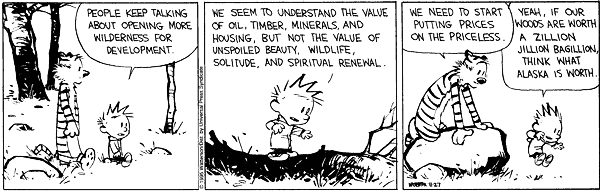
Price Tags


The world believes and understands only those things that have a price tag around their necks!?
Check out what Calvin and Hobbes think about it....
Aren't KMs (Knowledge Managers) facing the very same challenge?

Monday, November 27, 2006

Collaboration - The Other Side

Staying away from KM evangelization for a brief period has actually helped me cure my obsession with KM. Even though my passion for the subject is as good as ever, I am at least not so blinded by the passion that I can’t think about the limits of KM. Simply put, I will now not go around calling KM the panacea for everything under the sun. I know enough to think about the difficulties and the predicaments associated with it.

I’ve been one of the strongest advocates of collaboration (For the uninitiated, collaboration is a key component of KM). Collaboration for learning; collaboration for speed; collaboration for innovation; collaboration for efficiency and effectiveness etc. I continue to be influenced by the concept and will peddle it as a solution for many organizational problems. But I’d like to explore the subject here from another angle and point out the troubles and tribulations of collaboration that need to be considered before embarking on any collaborative process/solution revolving around collaboration.

  1. Collaboration will not be equally effective in all environments

Imagine three different organizations with the same challenge - Slow learning amidst high growth (business and employee growth). One of the key solutions to tackling this situation could be a framework for collective learning. Even if the challenges in the three organizations are exactly the same, the collective learning framework – however exhaustive it is – will not have the same effect on all three. The difference in the outcome would lie more often than not in the surrounding environment. The environment refers to the management attitude (do they talk about the need for collective learning and sharing and lead by example?), the physical workspace (does it have high walls?), the experience of the seniors (how much do they actually know to teach and be open enough to learn in case they don’t know enough?), the novices’ willingness to learn (are they motivated and interested enough to learn), the ability of seniors to teach and learn (how good are they at explaining), the availability of technical enablers (do they have efficient telecommunication lines, do they have tools that help them ask questions, answer them, jot down thoughts, store them for later use etc), the work pressure (is there so much work that people can’t concentrate during conversations?) etc

  1. There are different styles of collaboration

This is very important. Even if the environment for collaboration exists, it needs to be understood that each person has his/her style of collaboration. It may be commonly felt that once people understand the importance of collaboration and are provided the environment to work together….things need to start happening. But this may not be the case because just as each of us has his/her style of working, we also have our own style of collaborating. It obviously cannot so happen that only people who have similar styles of collaborating work together….so, there does seem to be a need to make everyone aware of the different styles, and train them to adapt themselves to the needs of the situation. I have attempted to explore some of the common styles/preferences below. I don’t think these styles are isolated in that people have only one way of collaborating….but there are likely to be some dominating traits amongst these in each of us.

-Some of us like to think together and be led by others’ thoughts, reactions, questions and inputs

-Some of us like to sit down and think quietly – in solitude

-Some of us need to work on the whole thing (like working on a document) all by ourselves and then send it to others for comments, feedback and suggestions

-Some of us are happy to take one chunk from the whole thing (eg: document) and then fit it into the right place

-Some of us do our best when the ownership lies with us

-Some of us do our best when somebody else take the ownership and we are involved only in the capacity of a consultant/reviewer

-Some of us collaborate well under pressure and vice versa

-Some of us like to converse our way through the problem while the rest like to get down to the nitty-gritty without much ado

-Some are worried about their role in the exercise and how much of the credit they’ll get

-Some are comfortable just using their minds while some others need a pen and paper or a marker and white board

-Some cannot collaborate with people whom they don’t know well enough

-Some prefer face-face collaboration to distributed collaboration

  1. Technology-enabled collaboration has its drawbacks

Technology-enabled collaboration is something that not everyone is comfortable with. Technology cannot do a perfect job of translating body language. There are people who are phobic about phones. Some of us don’t seem to be able to get personal and comfortable about discussion boards. Some of us hate to write because of which we don’t contribute to virtual workspaces that depend on discussion boards and repositories and chats rather than voice exchange. One tool may not be sufficient to meet the needs of the situation. Not everyone is dexterous enough to handle multiple tools for collaborating – telephone, online whiteboard, presentations, videoconference etc

  1. Collaboration is hard to sustain

Even if everything is conducive and people are motivated to collaborate and work together on a continuous basis, more often than not, they will encounter stumbling blocks along the way. These stumbling blocks can put a spoke in the wheel of collaboration and stop it from running. Work load and pressure are common culprits that prevent people from looking outside their own ‘selfish’ responsibilities. Response from the organization, peers and managers can also determine the success or failure of collaborative endeavors. An organization where people are used to finger-pointing behaviours, divide and rule habits, search for individual glory, rewards and incentives will find it hard to sustain collaboration.

Friday, November 24, 2006

M A D?

You're only given a little spark of madness. You mustn't lose it. - Robbin Williams

So what if people call you mad? I think it is this little spark of madness that identifies you! :)

Thursday, November 23, 2006

gOOgle stOOry

A lot of interesting tidbits about my favourite company... :)

Amazing People....

If you want to be inspired by people who walk the talk and are truly spiritual, try this.
Nipun and Guri have a blog that talks about their values, views and daily adventures. They are an amazing couple who seem to have given up most of the materialistic desires that humans are subjected to and are the epitome of kindness...

Wednesday, November 22, 2006

Why Blog?

http://www.babsonknowledge.org/2006/05/a_storytelling_story.htm

Don Cohen finishes off by saying "The person who learns most from the story is often the one who tells it."

Now, that is precisely one reason why I love blogging! :-)

Winners All? Losers All?

While watching a dance competition-based programme on TV last week, the team that lost in it broke down. And my mom said "Nobody likes to lose!".....A simple statement perhaps....one that is obvious and one that is stated in more ways than one....but it got me thinking on that particular occasion.

Some of the sports events like Tennis, Cricket etc sometimes show the losing team/person saying things like...."Playing is more important"....or "We are/I am glad we/I lost to a better team/person"...."I enjoyed the game even though I did not win" etc etc....but how many of us really are detached enough to not mind losing?

The book that I am reading on Tao says that losing is not about the other person winning!....Meaning....just beccause the other person has won...it doesn't mean you've lost....win-win is winning...but one has to admit that sports events are no events to take this philosophy into consideration. The world of sports is ruthless....

Coming back to the statement that "Nobody likes to lose"....I think this is simple but profound...If one is ready to 'lose' and accept 'defeat' life will be a lot more enjoyable and peaceful. What?

Tao-Post #2

Still on Tao....the book I am reading has a chapter on Conflict Resolution and is worth a read....two key points that it talks about are....when on the verge of a conflict or in the midst of one....suspend judgement and be patient... :)

Maaza Mango

Have you seen the latest advt. for Maaza? I think it's a cool one! :D

Scene 1: Gardener and his dog are sober. Gardener narrates a story - He and his dog have been deprived of the fun they used to have when in earlier times they chased away kids who used to steal mangoes from the garden. Now, Maaza has become a wonderful substitute for real mangoes...so there are no more naughty kids to chase. (There may be a flaw in the logic here.....but I choose to ignore it. If kids can pay for Maaza....why did they not pay for the mangoes? :-) )

Scene 2: Gardener replaces mangoes with bottles on trees. :) Kids come back to steal Maaza and the gardner and his dog are given back the joy of chasing the kids all over the place... :)

Thursday, November 16, 2006

TAO

I am finally reading something....reading a book called The Tao of Personal Leadership by Diane Dreher

And here's something nice that I found in it....actually the entire book is worth quoting but of course, I can only choose some things that struck a chord in me...hit me harder than the rest... :)

North American Tool & Die became a successful corporation within eight years by setting three corporate goals: to make a profit, to share the wealth with the staff, and to have fun. *The second two goals helped them achieve the first* by building a strong team spirit.

The Tao leader
Looks beyond friend and foe
Profit and loss
Fame and disgrace
And therefore prevails.

Excellent book for those interested in spirituality and personal development...!

In tune with Intuition?

Came across an article entitled 'The power of intuition' in The Week dated Nov 5th 06. This article was probably inspired by Malcolm Gladwell's Blink. Found some interesting tidbits that I thought I'd share with you...

"Have the courage to follow your heart and intuition. They somehow already know what you truly want to become" - Steve Jobs

"A uniformed man with a gun in hand and an enemy in range definitely acts on intuition" - Sarabjit Singh - former director-general of police

"The misconception about intuition is that it is different from logical thinking. It is an advanced stage of logical thinking" - David Myers

"It is by logic that we prove. It is by intuition that we discover" - Henri Poincare

"Intuition is how you turn experience into action. It is the set of hunches, impulses, insights, gut feelings, anticipations and judgements stemming from pervious events in your life..." - Gary Klein in The Power of Intuition

Intuition apparently does not work when one is in an emotional state - stressed/bad mood etc

Yet another paradox

I love watching quiz programmes and have always seen the conventional ones that are run by a quiz master who poses all the questions and gives away the award to the one who gets the maximum number of answers right. But someone applied paradox thinking on the concept of quiz games. Any guesses on what that could have resulted in? Imagine the 'quiz master' answering 'questions' /arriving at an answer? Sounds ridiculous? It may....at first... :D

Vijay TV airs a programme called Grand Master wherein he gets common people as well as celebrities to participate in his show. The game is for the participant (one at a time) to think of a celebrity and then answer a maximum of 20 odd questions by choosing a yes/no/don't know till the quiz master discovers who the participant is thinking about. Now, this may be an old game that we've all played in school - Who's that - but it is the first time that I have watched such a professional programme on TV....and I love it.

Paradox thinking is cool! :)

Monday, November 13, 2006

HeART Vs HeAD

There are people whose thinking is spearheaded by the head and those whose thinking is led by the heart. Logical thinking Vs intuitive thinking...

Which of these two categories has more number of HAPPY people? Those who let their head dictate? Or those who let their heart dictate? Please respond in case your head/heart tells you to....whichever the case may be. :D

Meanwhile, here's another thought that crossed my mind recently. Why does everyone love music? Almost everyone....

I haven't actually seen people who dont love music/listen to music though there are various degrees of obsession.

How is music composed? Does the composer use his head? I dont certainly think so (But you can challenge me or prove me wrong). Music has to flow...from the heart. Wrong notes are recognized by the heart....not the head! So, is it surprising that the whole world loves a product of the 'heart'??? And this is one product that can make a tired/sad/angry/stressed out (wo)man smile!

Products of the head are interesting but only in the short run....they change our lives...yes....but can anything on earth beat music or any other product of the heart????

Thursday, November 09, 2006

Google's KM Product?

http://nirmala-km.blogspot.com/2006/03/google-dodges-knowledge-management.html

Earlier, I'd wondered about Google's KM ambitions and watched Google get into desktop search, enterprise search, blogging, personal pages, google talk etc. Now, I hear that Google has acquired JotSpot - a Wiki product company. Where to next? :)

Mark my word. Down the line, it may be more than apt for Google to bundle a lot of these smaller products they have/are working on/planning to acquire into one cool KM product! And then, the rest of the KM product companies may have sleepless nights....the power of a brand can never be under-estimated!

Wednesday, November 08, 2006

Calvin's Paradox

There are paradoxes everywhere. Here are two paradoxes I “discovered” today! :)

One of them was in today’s Calvin & Hobbes subscription strip….

Calvin (screaming aloud): “I am in a crabby mood, so everybody just leave me alone! I hate everyone!”

Goes around with a grumpy face in the next scene. Then looks around with a surprised expression.

Then, says: “Nobody recognizes my hints to smother me with affection”.

End of strip.

Isn’t that true? A lot many times, we claim to want to be alone but are actually looking for a kind soul that will make life easier!

Another in a joke I heard long ago…in Tamil…..translating it into English here….may sound silly…but serves my purpose and demonstrates paradox thinking! ;D

Patient: “Doctor, my eye hurts….it’s been so for a long time but I am confused….there seems to be no sign of a wound or anything else that could cause it to hurt”

Doctor: “What have you been doing? Rubbing it a lot?”

Patient: “Yes….!” and then shows what he’s been doing….(rubs his eye with his right hand index finger)

After a pause….Doctor: “Ok. I know what your problem is. It’s not with the eye. It’s with your finger.”

And then points out a wound on the patient’s index finger!

LoL :D

Monday, November 06, 2006

KM Course - Post #5

Continuation of 'Leveraging on existing knowledge':

Having looked at some of the fundamental principles that form the foundation for making use of existing knowledge, let's go on to understand exactly what is existing knowledge and how it has to be leveraged upon:

What is the existing knowledge that needs to be made good use of?

- Business knowledge
- Domain knowledge
- Functional knowledge
- Process knowledge
- Customer knowledge
- Employee knowledge (people skills)
- Market/Environment knowledge
- Competition knowledge
- Technology knowledge

Knowledge could be those that can be

- Documented - completely explicit - Organizational structure
- Taught - How to reach a place - shortcuts/what to do in certain situations etc (maps may be a good documented substitute though)
- Taught, observed and learned through practice - How to conduct meetings

Each knowledge type has to be shared and made good use of through different techniques and tools. Making good use of existing knowledge implies the following:

- If I've done it once, I should be able to do it again more efficiently/effectively
- If I've done it once, I should be able to teach someone who has not yet done it or someone who tried it differently and did not learn what I learned
- If I've done it once in a certain way and someone else has done it in some other way, we both get together and learn from each other and put together the best of both and mutually benefit
- If I've done it once, I document it and circulate it to a large audience who not only learn from it but also keep adding to it so as to improve it and provide alternatives

The culture has to be ready to learn and share...independently and collectively.
The processes have to be ready to accommodate for learning and sharing activities. Anytime, All the time
There ought to be tools that help people learn and share...independently and collectively.
The sharing has to haapen through the right channels at the right time and to the right people and has to be made available forever....though it keeps changing its shape and size and form as it evolves and changes with time....!

For all this to happen, the organization has to identify the knowledge that's important for the business, understand how, who, when, where and why knowledge is generated, enable it to be shared, provide an environment for people to learn and generate the knowledge and understand how it is used and provide the necessary tools and cultural orientation required.

Friday, November 03, 2006

Somebody asked....

Somebody asked..."Does KM produce business benefits or is it an esoteric subject?"....and I think...

Yes and Yes! :)

Practicing KM definitely produces business benefits though how it can be quantified is not only a challenge in some ways but also is a matter of perception....and therefore an esoteric subject in the eyes of people who claim to be KM experts! :) Jokes apart, KM is an esoteric subject in the sense that only those who are comfortable talking about intangibles and things that are all-encompassing understand it....or rather try to understand it.

Moving back to quantified business benefits....if, to achieve a business goal, the concepts of KM are utilized, there are people who may attribute the entire revenue/profit/rating/brand perception, as the case may be, to KM! For example: Someone networks with a key customer contact and realises in the normal course of the conversation that the customer has an implcit requirement and comes back and puts it up on a discussion board which is in turn commented upon by various team members and managers and finally results in a proactive proposal that the organization wins.....?! Some people would say it was KM that made it possible and some others that it was the technical/functional solution that made it ultimately possible! So, isn't it about perception?

But there are clear situations like that involving Customer Queries/Responses and a database that stores previous queries/responses that improve customer response time and this can be quantified in clear terms....!

This is a vast topic and can be spoken about at length. Stopping here for now! :)

Tuesday, October 31, 2006

The Buddha Speaketh Thus

Thousands of candles can be lit from a single candle, and the life of the candle will not be shortened. Happiness never decreases by being shared. - Buddha


technorati tags:, ,

Monday, October 30, 2006

KM Course - Post #4

Having said that KM, simply put, is a management philosophy that deals with leveraging on existing knowledge and creating new knowledge from old knowledge...we went on to see that a good starting point would be to understand how to make best use of existing knowledge by aligning our activities with the business goals. What could be the business goals (and corresponding road-blocks) that need to be considered in the context of KM...and especially in the context of existing knowledge? Which of the typical business goals can be achieved with KM as an enabler? Which of the corresponding road-blocks can be cleared with the aid of KM?


Let's take some examples: Typical business goals would concern themselves with revenue growth, cost-cutting, innovation, productivity, employee satisfaction, customer satisfaction, and brand image. Logically speaking, cost-cutting, productivity improvement, employee and customer satisfaction are areas which involve making best use of existing knowledge in an organization. Making best use of existing knowledge simply means making knowledge accessible to the right person at the right time and in the right format. This will ensure that employees are able to go about their duties without unnecessarily wasting time, effort and money. They end up reusing artifacts already prepared by others in the organization thus not only improving productivity and cutting costs but also improving employee satisfaction and customer satisfaction in case the activity concerned has a direct impact on services provided to the customer!


The underlying KM principles among others would be:

- Designing and executing processes so as to identify the importance of the knowledge being handled and capturing/sharing the same. Systems need to be designed to capture explicit components of the knowledge and alert concerned people about the availability of explicit knowledge. Systems also need to remember the people who can provide more information on the project when needed thus capturing information about the availability of tacit knowledge

- Making knowledge capture and sharing a way of life for each and every employee by not only designing processes appropriately but also providing them with the right tools to do so. These may be sophisticated tools that are on a network 24*7

- Most importantly, people need to educated about the importance of (and opportunity loss involved in not) capturing and sharing the knowledge. They need to be encouraged, acknowledged, appreciated and celebrated for such activities.

Next post: Continuation of the discussion on how to leverage on existing knowledge

technorati tags:

Friday, October 27, 2006

KM Course - Post #3

Ok! Let's start off.....Having said that KM is about leveraging on existing knowledge and creating new knowledge for business benefits....how does one go about it?Let's take it one at a time. Let's focus first on leveraging existing knowledge...Leveraging on existing knowledge for the logical sense that it makes is one thing and doing it because the business situation desperately calls for it is another!


Ideally, unless the business leader under question is inherently a believer in the logic that existing knowledge needs to be circulated and made best use of and that it is worth INVESTING in financial terms and otherwise (time, other resources), it is better to let the business objectives dictate to the KM plan.So, what we ought to do is to study the existing business objectives and the future business objectives and look at how it needs to be achieved and the role that existing knowledge would play in the same. We also ought to look at the problems or the stumbling blocks/pain areas that the business faces currently and the role that knowledge has to play in the given scenario and prepare a KM plan accordingly.


Next post: So, how does one plan to leverage on existing knowledge.....?


Tuesday, October 24, 2006

A short -blog- course on KM...

Ok! Here goes! I've been stimulated enough to think about the definition of KM which you can read below. So, I think it's going to be easy for me to keep the momentum and go on and build on this and prepare a short blog course on what I know about KM...! :) What say?

technorati tags:

My new (?) definition of KM.... :D

KM is a management philosophy that deals with the optimal utilization of existing knowledge and the creation of new knowledge to meet business requirements while satisfying corporate values. - Nirmala (24th Oct 06)

technorati tags:, ,

Thursday, October 19, 2006

Doctor. Different!

I came across a very unconventional Doctor in Dubai. An Indian by birth, he has studied to be a heart surgeon but is now pioneering a different kind of service for people (not really patients). He has taken up idea of being a health consultant for people who are willing to get proactive about their health. But it works for reactive cases too. He apparently promises an improvement for the better based on the person's needs and does this once he has studied the person's health at length. He analyzes the person's health and looks into the future to prescribe proactively, at what is perhaps a reasonable fee for a well-to-do family. I guess there is a significant difference between a dietitian's inputs and inputs from a person of this sort. Come to think of it, the benefits this may have would be related to early diagnosis of health problems. The doctor says his 'customers' are forced to sign an agreement to the effect that they'll make themselves available for discussions with the doctor anytime he chooses and vice versa! Prescriptions may range from exercise, food, lifestyle recommendations, etc. Well, whatever it is, I think it takes guts for a well-established doctor to move away from what could be a well-paying job to something that is quite risky and uncertain! A surgeon without practice may not even find a job if he has been away from his profession for too long a time!It is not only about being visionary, innovative, different, unconventional etc but also about knowing when (the right time) to take the less-trodden path!

technorati tags:,

Friday, October 13, 2006

Unwanted advice?

If there is...

- no top management support for KM (includes their willingness to talk about the importance of KM when talking to the workforce)
- no Management/HR-driven culture of acknowledging knowledge sharers/mentors rather than individuals who accomplish but hoard

...KM will not work!

You can as well get ready to see 80% of your effort going down the drain. It is indeed the pareto rule at work. 80% of KM will arguably happen if there is just 20% in place - management support and a culture that pampers those who share. The KM's job is a lot easier then....(she of course then needs to work on improving those processes, communicating effectively, making the technology fascinating, evangelizing et al)

Monday, October 09, 2006

Keep It Short, Stupid

The secret of a good sermon is to have a good beginning and a good ending, then having the two as close together as possible. - George Burns

:D ah! and ha! as well... :]

technorati tags:,

Saturday, October 07, 2006

Under the Table

During a presentation yesterday, the speaker was having continuous problems with the power chord & the projector and in the process had to go down on his knees to reach the power point just under the table. After grappling with the technical problems for a while, he said with a grin that barely hid his disappointment "You know when a presentation is going really bad when you have to go under the table!" :D LoL

technorati tags:

Principles and Values: A Life's Life?

How many of us formulate our own principles of life and live by them?
I have begun to see a pattern and 'am curious and excited to explore it further. (High time I did I guess....I am sure there are plenty of people out there who are smarter and have observed a lot more....much earlier than I have in my life....and I would love to hear from them).

Every person who has created waves in the world, every person who has accomplished something extraordinary, every person who is admired and respected by the world has a key principle/set of principles that (s)he follows and swears by... Among these are some who are so passionate and sure of themselves that they influence and mentor others to adopt those principles (Spiritual Gurus, Political Leaders etc). Is there something that can be called a common principle that makes an appearance in almost every famous person's diary? Or can these be categorised roughly into a dozen/half-a-dozen buckets? Won't at least one of these sets of principles appeal to any given person? (I am sure it will...).

I think schools should have a subject that stimulates such thinking in children. The subject of principles and values. Not necessarily forcing children to adopt something but inspiring them to discover (can't be invent I think) the principles and values that drive him/her. The world will be a better place to live in if each one has wonderful principles/values that go along with others' principles/values or at least do not clash with those that others have...

All Relegious leaders definitely seem to have advocated a few common principles like kindness, tolerance, honesty, sacrifice et al. Principles by MK Gandhi, MLK, and Nelson Mandela belong to one category that was driven by similar causes. Swami Vivekananda was a man with wonderful principles. Ayn Rand's principles may not have been accepted universally but there are many people who are influenced by them. Many Indian sages (Ramakrishna Paramahamsa, Ramana Maharishi, Adi Shankaracharya) including Sri Sri and Swami Chinmayananda are examples of principle-led lives that influence a huge circle of people.

I think it would be wonderful for each one of us to spend time and study the lives of great people, listen to contemporary principle-led leaders with an open mind and then form our own set of principles and values that drive us and inspire us come what may. It would mean a very satisfying and fulfilling life and what more does one want? I guess some of these principles may be based on a goal (for example, Gandhi's) while others are just principles that help one lead one's life well...

...I will start my conscious journey today. :-)

Tuesday, October 03, 2006

The RUSTing of TRUST

Just been reading an article on Trust in HBR (This month’s – September 06 - Issue). Written by Robert Hurly and entitled ‘The decision to trust’.

The author says trust is more often than not the result of analysis and not blind faith or paranoia. He says there are ten factors that determine whether one resorts to trust or distrust in their dealings; 3 of which are related to one’s own personality and the remaining 7 to the situation one is in.


The three personality related factors are: (statements in parenthesis reflect my interpretation)


-          Risk-tolerance (are you ready to take a risk and trust someone?)

-         Level of adjustment (how much adjusted are you with life? do you believe no one can cheat you?)

-         Relative power (how much can you ‘get back’ at the person if he cheats?)


The situation-based factors are: (not necessarily in the below-mentioned order)


-          Security (is the situation that involves delicate security-based issues?)

-          Similarities between the two parties (similarity breeds trust)

-          Aligned interests (does the person want the same things as you do and will she do everything for it?)

-          Capability (is the person capable enough to carry it out)

-          Predictability and integrity (uncertainty never helped?)

-          Level of communication (frank, open and complete communication improves trust)

-          Benevolent concern (you will trust a person who is genuinely kind and lets you know that she wants you to have the best)


--------------------------------------------------------------------------------------------


KM thought-leaders have for long screamed from roof-tops about trust being one of the most essential ingredients for it (KM) to be a success in any organisation. But how much of it can be influenced by the KM function/initiative? It is clear that trust is too fundamental, person-based and situation-based for KM to play the role of an influencer. Underlying enablers like communication, capability, risk-tolerance etc can be worked upon with adequate top management support but most of the factors on the list are out of control and hugely associated with the individual’s character and attitude. Knowledge sharing is truly effective only in teams where all the above barriers are crossed….and the situation based factors are difficult if not impossible to handle. Extending this topic a little further…into a slightly different direction, this is a selling point for K-Logs. A knowledge blog written on a personal note with details about the good and the bad (not just the former) is trustworthy and a good candidate for knowledge sharing mechanisms; One of the sure-fire ways to build trust in the online world, as there is a sure but gradual movement to online presence and interaction from conventional methods of interaction…

Friday, September 29, 2006

Deriving Strength from Words

Came across a couple of quotes that sound so great….really, don’t you think we underestimate the power of words many a time?

What a few words strung together with the threads of optimism and inspiration cannot do! :)


“People are just as happy as they make up their minds to be” – Abraham Lincoln


“You can’t have a better tomorrow if you’re thinking about yesterday all the time” – Charles Kettering


Talking about words and how they make people react, I think many organisations don’t make use of the techniques of communication (words, of course, play a key role in communication) to manage change…the easiest way to get things done is perceived to be through enforcement and superficial rewards. Words (communication as a whole, actually) can actually be the cheapest way to get things done….managers who use words manipulatively may succeed in the short run but leaders who can genuinely inspire and have the communication skills required for it would be extremely successful and powerful in the long run….


Thursday, September 28, 2006

How do you do?

How do you do
How do you do,
originally uploaded by nimmypal.
An unexpected gift....was observing another bird but ended up catching this one on the lens....and at an amusing moment too! :)

At the start of the desert safari

At the start of the desert safari
At the start of the desert safari,
originally uploaded by nimmypal.
Words cannot do justice to this photo....in other words, I am not in a mood to write ;)

Thursday, September 21, 2006

Vigilant vs. Operational Leaders: Changes at Ford, the Coke-Pepsi Fiasco, and Other Management Moments - Knowledge@Wharton

http://knowledge.wharton.upenn.edu/article.cfm?articleid=1553&CFID=1079949&CFTOKEN=92784412

Yeah! I am back to doing one of my favourite things....reading up on the latest articles from the top business school magazines on management, leadership, innovation etc. I sort of liked this article as it tries to differentiate between mundane leadership and vigilant leadership. It is a story of risks and attitudes that encourage/discourage risk-taking and long-term thinking....reminds me of one more thing that I came across somewhere....it's about getting out of your comfort zone and seeing reality for what it is.

Monday, September 11, 2006

B-R-I-D-G-E

If destiny has taken you places, which bridge do you think is the most awesome of all?

PS: I am gathering information on bridges as I personally am fascinated by them....especially those that look unconventional....some of them are truly man-made marvels I think...

The line between theory and practice...

It may be easy for the theoretically inclined to switch into the practical mode but not so for the people who belong to the second category. Am I right or am I right? ;D

Sunday, September 03, 2006

T-H-R-O-W ing, a Fit? Throwing a fit?

Sometimes, life throws such seemingly menacing situations that seem like it will be the end of the world before they occur (something i am not ready for...it just can't happen to me...) and then like 'even this will pass'....or 'what else could I have done anyway...it doesn't matter'...or 'it did not kill me...i got through it....i made it' once it occurs..

Amusing....amazing....interesting....and what not! I recently went through one such situation....I had to throw away a lot of stuff that I thought I would never ever throw away...for even a million dollars...but I had to....thanks to the new airline baggage rules... :@...and thanks to some very 'friendly' and 'understanding' airline staff (ouch!...it is too hard to digest) from one of the airlines that is considered to be the best in some parts of the world (Middle east and Western region)! Boy, I simply closed my eyes and threw stuff like I'd been wanting to dispose them for ages while in reality it was anything but that. After the terrible experience, I happened to come across a newspaper cartoon quite coincidentally....it shows a guy with so many bags that he has to literally make use of his teeth to show his ticket and the caption reads 'Before 9/11' and then the second box shows the same guy without anything on and using just the ticket to 'clothe' himself.....if you know what I mean....! Boy, the situation couldn't be expressed better now I guess...and this is no joke.

At the risk of sounding highly philosophical, if you ever encounter a situation wherein you have to discard many a KG at the Airport and are either not prepared for it or just partially prepared for it....one way to look at it is as a spiritual experience. What will you throw? What is the criteria? How much did you pay for it? How much do you love it? What will you lose if you throw it? God! How many important questions to answer and how less a time to answer it in. A few minutes of hectic throwing and spiritual cleansing if you like....I'll probably come back and write more about this. But all I can say now is that life is just amazing at times....it loves to give you a surprise and see how you react to it....and however much you believe that you are not equipped for it, life also actually gives you the wherewithal for handling the situation. Believe in yourself!

Saturday, August 05, 2006

D.E.A.T.H

Death is a strange thing to encounter. Everything is forgotten and forgiven when there is a death. At least, by most people. Even if the person who is dead was not someone who was particularly helpful or a great human, everyone around rarely recalls such matters. Death is a strange thing. It makes one realise that there is simply no escape. Everything ends. Everything ends with death. If there's anything beyond death we don't know it....

Death thy appearance...
Is the time when ironically somethings begin to make sense!
For one of the souls though...
It is the final bow!
For those around it may be too hard a blow
Even if the person who left was not a great bloke
The experience; it brings to the fore
The fact that death is perhaps life's core!

Sorry if that poem makes no sense....I may just be babbling...

Asterix and Oberlix - A paradox

Came across a cool paradox in 'Asterix and the Normans'. The statement is credited to Getafix, the druid, in the book.

It is something on these lines...

"The truly brave are the ones who have overcome fear. Courage exists only where there is fear"....Courage lies in the overcoming of fear....

Saturday, July 22, 2006

Blog Ban?!

I heard from one of my friends about the Indian government issuing orders to block links to blogs including ones hosted on Blogger! Was appalled by the step. Almost seemed like we are in the prehistoric world! What do we have here? Where did our freedom of speech vanish? When we can say what we feel like via other mediums like TV, Radio, Print et al, what's so intimidating about blogs? Is it that they have a much wider reach? Or is it simply that blogs are easier to block!? How can politicians who have been voted to power by the people stop those very people from even expressing themselves? If this is a case of certain miscreants up to no good, then why doesn't the government just 'take care' of them? Hmm! Lots of questions, many a stirred emotion, no clear answers.....

If you know better and know what's the latest, please leave your thoughts here....

Plum Party

Joining the party are some more books.... :D

6. Aunts aren't gentlemen
7. A few quick ones
8. The old reliable
9. A gentleman of leisure
10. Spring fever

Three cheers to the Solihull Library!! Hip Hip Hurray! :)

Tuesday, July 04, 2006

Providence, PLUM and I

I ought to be jumping up and down with joy...really! Providence has helped me get my hands on some PLUM (P G Wodehouse) books that I had earlier combed Bangalore's bookshops and libraries for but in vain. Though these books are from the library and I can't possibly think about owning them, the fact that I've an opportunity to at least read them once in my life is something to be jumping up and down about. The books that I've got so far (and hopefully I will get to read more than this if I am around in UK longer) are...

1. Very Good, Jeeves
2. Something Fishy
3. Doctor Sally
4. Louder and Funnier
5. The Small Bachelor

:-)

Reading book # 2 now. Came across this yesterday and laughed away to glory....

"Poverty is the banana skin at the doorstep of romance". Haaaa Haaa Haaa :) What prose, o boy! Hats off to the one and only PLUM...eh?

Update: I've managed to read a lot more of PLUM's books
- A gentleman of leisure
- The old reliable
- Wodehouse - A life by Robert McCrum
- The girl on the boat
- A few quick ones
- Aunt's aren't gentlemen
- Ice in the bedroom
- Bill the conqueror
- Money in the bank
- Do butlers burgle banks
- Indiscretions of Archie
- If I were you (This one's wonderful)

Monday, July 03, 2006

Blogs and the future....of the world

I've been wondering about this since yesterday.

What if someone were to have all that it takes to run an intelligent tool through all the blogs in the world and find out...

1. Which country has the maximum number of blogs?
2. What are the profiles of the people who blog in each of the countries? (Age, Gender, Education, etc)
3. What are the most popular topics that are blogged about in each country (alongside information about the people who belong to a particular type-set.....for each of these topics)?
4. What are people generally thinking about things that have a direct impact on the economy of their country? (Money, Share-market, Spending, Saving, Careers etc)
5. Is there some sort of a world-trend that can be predicted by mining all this information being poured into blogs day in and day out?

Any answers? You must be having some thoughts if you are into Business Intelligence, Data Warehousing, Data Mining and the like...!