Thursday, October 06, 2005
Nimmy's ES....ha ha ha (Last Part - Part III)
For an organizational KM initiative to be a huge success or at least accomplish something significant at the end of the day, I think there is a definite need to ‘over’ communicate the need for KM. Some people will not be happy about being consistently bombarded with communiqués but as soon as they see a smooth transition into the demonstration of the benefits of KM, the noise would die down. Also, the communiqués would generate conversations and discussions which are a must for an initiative like KM to take off. Out of sight, out of mind is a cliché to be remembered. The communication needs to driven by the organization’s leaders and more importantly they need to practice what they preach. The association between KM and Innovation needs to be drawn clearly; the organization needs to move away from individual recognition and towards team rewards - to the extent that it doesn’t seem silly (eg: loose recognition and praise given to an entire team for an obvious piece of work done by an individual would be no less than ridiculous). Individual rewards need to be handed out, but the criteria should be designed based on the sharing tendencies of the individual more than anything else. If a person who does well at work but hoards knowledge is rewarded and encouraged, further chatter about knowledge sharing will clearly result in cynicism and bitterness in the team. Overall, I strongly believe that consistent and persistent communication that inspires and corresponding practices from the leaders of the organization may be a panacea of sorts for KM….it will surely have a great impact on the effectiveness of the KM initiative while perhaps not contributing so much to the efficiency (productivity, processes, techniques etc) of KM activities.


Monday, October 03, 2005
Nimmy's enlightening statements....ha ha ha (Part II)
Why would Corporate Blogging be successful?
Blogs have a personal feel to them. They are self-centric and will not, in my opinion, be seen as a “here’s-how-you-can-help-others” initiative by the bloggers themselves, even though, in reality, that is what it may be. What kind of a feeling will one get when one picks up the pen and writes into one’s diary? One of altruism? Noh! Actually, ‘good’ bloggers get the due recognition and following even while others are benefiting out of the blogger’s knowledge. So, blogging will work better than asking people to write articles and papers and upload it into the repository for the ‘benefit of the rest of the organization’! I got to add that it will work…unless you are dealing with a lot that is overtly cautious and suspecting of its colleagues/a lot that hates writing and is highly oriented towards auditory learning/a lot that works in a scenario that is so badly organized and planned that there is no time left for writing (which, admittedly, can be time-consuming).
Blogs have a personal feel to them. They are self-centric and will not, in my opinion, be seen as a “here’s-how-you-can-help-others” initiative by the bloggers themselves, even though, in reality, that is what it may be. What kind of a feeling will one get when one picks up the pen and writes into one’s diary? One of altruism? Noh! Actually, ‘good’ bloggers get the due recognition and following even while others are benefiting out of the blogger’s knowledge. So, blogging will work better than asking people to write articles and papers and upload it into the repository for the ‘benefit of the rest of the organization’! I got to add that it will work…unless you are dealing with a lot that is overtly cautious and suspecting of its colleagues/a lot that hates writing and is highly oriented towards auditory learning/a lot that works in a scenario that is so badly organized and planned that there is no time left for writing (which, admittedly, can be time-consuming).
Friday, September 30, 2005
Nimmy's Enlightening Statements...ha ha ha (Part I)
Knowledge sharing is so tough to promote and make it happen because of 2 primary reasons - greed and fear.
We are all greedy for more. More money. More love. More that. More this. Apropos, some are greedy for more information and knowledge than others. They would love to take. But they don't want to give. Even if they give, they give the useless or maybe what they perceive to be useless. No knowledge.
We all fear certain things. Some fear animals. Some fear fire. Some fear death. Blah. Blah. Apropos, some fear that people will take away what's 'their's'; some fear they will not get what they give; some fear they will be taken advantage of; some fear being 'used'. So, they don't give knowledge.
We are all greedy for more. More money. More love. More that. More this. Apropos, some are greedy for more information and knowledge than others. They would love to take. But they don't want to give. Even if they give, they give the useless or maybe what they perceive to be useless. No knowledge.
We all fear certain things. Some fear animals. Some fear fire. Some fear death. Blah. Blah. Apropos, some fear that people will take away what's 'their's'; some fear they will not get what they give; some fear they will be taken advantage of; some fear being 'used'. So, they don't give knowledge.
Advertisements/Selling and EQ Vs IQ
From Zig Ziglair’s newsletter:
People buy emotionally first and logically second!But sales people often (maybe most often) attempt to sell logically first and emotionally second (if at all). People won't buy in reverse order.You can explain why your product (or service, or your point, when talking to a colleague or family member) makes sense, or why your price is affordable, or your product is the best on the market, or your decision is best for everyone involved . . . but until the customer experiences the emotional desire to buy, you're not going to make your sale.Don't put the cart before the horse by trying to sell the logic first. Get people excited about what you're selling and they'll come up with the logic on their own! It's true. Think about a significant or unusual purchase that you recently made for yourself, your business, or your family. It might have been a new computer, a new car, a new set of golf clubs, an expensive vacation, or a special gift. Think about your buying process. Did you sit down and figure out how the purchase made sense before you got excited about making the purchase? Or was it the other way around?Yes, people get excited about what they want to buy, and then they figure out how to justify buying it. That's not always the best way to make a purchase because oftentimes we buy things we really don't need, or can't afford. But nonetheless, it's the way people buy.If you're selling something that people really do need, if you'll help them get excited first, you'll get more sales.Now that you understand why people buy, take a look at the five reasons why people won't buy from you:1. No need.2. No money.3. No hurry.4. No desire.5. No trust.It doesn't matter how good your product is, or how fairly it's priced. Where these reasons occur, a sale doesn't.
------------------------------------------------------
Methinks:
Well, well – how true! That’s why we need advertising. Don’t we? Ironically, but not surprisingly, one of the fundamental concepts in advertising - AIDA – acknowledges the above-mentioned ‘logic’. AIDA stands for Attract, Interest, Desire, and Action. Thus, it proves beyond doubt that advertising has got to grab the prospect customer’s emotions first and only then (but not in all situations) present a logical case. But it would be unethical to emotionally trick people into buying just because you want to make money! That does bother me a bit. If you don’t see a need for the customer to buy it, in my world, it would be unethical to ‘trick’ the customer emotionally just so you can sell and make yourself wealthier. If you do it you would be a politician – a demagogue. Influencing the customer to ponder over the need and see if it would resolve a problem he is facing is, of course, all right. If it is a competitive pitch, you need to first differentiate yourself from your competitors and then use the differentiating factor in your emotional pitch. If certain segments of the market can relate to your pitch and thereby ‘fall’ for it, that’s absolutely fine. You deserve the attention because you are ‘different’ and are catering to particular emotions and requirements. I find myself convinced that the very concept of advertising is about emotional pitches rather than logical selling except in a few rare cases. Even if you were to point out some advertisements based on logic alone, I would ask you to go back to it and examine it closely for you will see a clear emotional terrain therein. The problem arises when the advertisements lie/manipulate rather than influence. Advertisements ought to be ethical emotional projects but they ought to speak on the basis of sound logical reasoning that will deliver to the customer what he needs! This is an interesting and controversial topic, I must say…can you think of any interesting advertisements that prove a point or two?
People buy emotionally first and logically second!But sales people often (maybe most often) attempt to sell logically first and emotionally second (if at all). People won't buy in reverse order.You can explain why your product (or service, or your point, when talking to a colleague or family member) makes sense, or why your price is affordable, or your product is the best on the market, or your decision is best for everyone involved . . . but until the customer experiences the emotional desire to buy, you're not going to make your sale.Don't put the cart before the horse by trying to sell the logic first. Get people excited about what you're selling and they'll come up with the logic on their own! It's true. Think about a significant or unusual purchase that you recently made for yourself, your business, or your family. It might have been a new computer, a new car, a new set of golf clubs, an expensive vacation, or a special gift. Think about your buying process. Did you sit down and figure out how the purchase made sense before you got excited about making the purchase? Or was it the other way around?Yes, people get excited about what they want to buy, and then they figure out how to justify buying it. That's not always the best way to make a purchase because oftentimes we buy things we really don't need, or can't afford. But nonetheless, it's the way people buy.If you're selling something that people really do need, if you'll help them get excited first, you'll get more sales.Now that you understand why people buy, take a look at the five reasons why people won't buy from you:1. No need.2. No money.3. No hurry.4. No desire.5. No trust.It doesn't matter how good your product is, or how fairly it's priced. Where these reasons occur, a sale doesn't.
------------------------------------------------------
Methinks:
Well, well – how true! That’s why we need advertising. Don’t we? Ironically, but not surprisingly, one of the fundamental concepts in advertising - AIDA – acknowledges the above-mentioned ‘logic’. AIDA stands for Attract, Interest, Desire, and Action. Thus, it proves beyond doubt that advertising has got to grab the prospect customer’s emotions first and only then (but not in all situations) present a logical case. But it would be unethical to emotionally trick people into buying just because you want to make money! That does bother me a bit. If you don’t see a need for the customer to buy it, in my world, it would be unethical to ‘trick’ the customer emotionally just so you can sell and make yourself wealthier. If you do it you would be a politician – a demagogue. Influencing the customer to ponder over the need and see if it would resolve a problem he is facing is, of course, all right. If it is a competitive pitch, you need to first differentiate yourself from your competitors and then use the differentiating factor in your emotional pitch. If certain segments of the market can relate to your pitch and thereby ‘fall’ for it, that’s absolutely fine. You deserve the attention because you are ‘different’ and are catering to particular emotions and requirements. I find myself convinced that the very concept of advertising is about emotional pitches rather than logical selling except in a few rare cases. Even if you were to point out some advertisements based on logic alone, I would ask you to go back to it and examine it closely for you will see a clear emotional terrain therein. The problem arises when the advertisements lie/manipulate rather than influence. Advertisements ought to be ethical emotional projects but they ought to speak on the basis of sound logical reasoning that will deliver to the customer what he needs! This is an interesting and controversial topic, I must say…can you think of any interesting advertisements that prove a point or two?
Sania, India
Sania mania – "Now, Tennis is Sania (in India)" says, my friend, Ashwini. True. Sania is 'everywhere'...not just on Indian tennis fans' minds and on the tennis court but also looking at us from out of billboards and talking to us from out of the Idiot box, asking us to trust a certain oil and petroleum major, a jeweller et al. Celebrity marketing in India is most certainly not going to take a break. As I sat thinking about the craze and madness, I saw the opportunities that are arising out of this case and before long, I was sort of proven right by a fact-based article on the same lines in a leading daily. There are opportunities amidst the madness….more people are, as I imagined, taking to tennis - which is good in my opinion. More people are choosing tennis as their career and life, more people are getting into the ‘business’ of tennis. At least in Hyderabad, where Sania comes from. What we need is, if there can be such a thing, a controlled mania (an oxymoron, I agree) once in a while….we need more leaders and trend setters in each area that is 'important' to us. For example, a charismatic person leading the initiative of ‘Save the tiger’ (Talwar, for example, is one passionate ‘tiger’ himself). The green revolution (Dr. Swaminathan) and operation flood (Dr. Kurien) are fitting examples. What needs to go with such phenomena is the media. Media can shape today’s youth by understanding the need of the hour and ‘blowing up’ the ‘right’ things in the ‘right’ manner. I think editors, columnist thought-leaders, journalists, television anchors, (and not to forget, authors) etc have a fantastic opportunity to shape the country’s youth. The responsibility that they carry on their shoulders is perhaps many times more than some people realize. They can slowly but surely make or break moulds and opinions and careers. The governing forces of the country need to get this clan of people on their side (or maybe vice versa :)) and collaborate with them.
Wednesday, September 28, 2005
Blog-surfing
Good Psychic Hygiene: Finally, some answers....
Amazing! Check this post out if you're interested in spiritual chases...
Amazing! Check this post out if you're interested in spiritual chases...
Managing Google's Idea Factory
Managing Google's Idea Factory
---------------------------------------
Cool! Innovation through KM. Come on, I can't take off my KM go(o)ggles, can I. It has become an extension of me...as much as the glasses I wear for short-sight. :)
And........talking of Google and Innovation, here's another thing I was thinking about.....
Let’s take one or more of India’s top IT organizations. They earn a little more than a billion dollars a year (as of 2004). On the other hand, let’s take - one of my favourite organizations – Google. Note: If Google isn’t an innovator, then I don’t know an innovator when I ‘see’ one. They (Google) make more than three times the money that any of the IT organization’s I refer to makes, with as little as one tenth of the workforce of the latter! Add to that the fact that the end-users of Google products/services don’t even have to ‘buy’ it from the organization!! That, to me, is the power of innovation.
---------------------------------------
Cool! Innovation through KM. Come on, I can't take off my KM go(o)ggles, can I. It has become an extension of me...as much as the glasses I wear for short-sight. :)
And........talking of Google and Innovation, here's another thing I was thinking about.....
Let’s take one or more of India’s top IT organizations. They earn a little more than a billion dollars a year (as of 2004). On the other hand, let’s take - one of my favourite organizations – Google. Note: If Google isn’t an innovator, then I don’t know an innovator when I ‘see’ one. They (Google) make more than three times the money that any of the IT organization’s I refer to makes, with as little as one tenth of the workforce of the latter! Add to that the fact that the end-users of Google products/services don’t even have to ‘buy’ it from the organization!! That, to me, is the power of innovation.
The Real Reasons You're Working So Hard...
The Real Reasons You're Working So Hard...
I love this article. Not only for its work-life balance theme but also because it points out KM as a sure-fire way to bring about work-life balance....with some caveats! :)
I love this article. Not only for its work-life balance theme but also because it points out KM as a sure-fire way to bring about work-life balance....with some caveats! :)
Teaching the Benefits of Balance
Teaching the Benefits of Balance
Methinks the root cause for most problems, not just this one, is our inability to see beyond the obvious/tangible and think long-term (what one of my colleagues might call 'myopic thinking' :))
Methinks the root cause for most problems, not just this one, is our inability to see beyond the obvious/tangible and think long-term (what one of my colleagues might call 'myopic thinking' :))
It hits me hard...
A Thought for the Day From Sri Eknath Easwaran
----------------------------------------------
September 26
A human being fashions his consequences as surely as he fashions his goods or his dwelling. Nothing that he says, thinks or does is without consequences. - Norman Cousins
The Hindu and Buddhist scriptures give us this same truth in what is called the law of karma, which is the psychological equivalent to the physical law that every action has a reaction equal and opposite to it. The Buddha says we can fly higher than the heavens or hide in the bowels of the earth, but we will not be able to escape the consequences of our actions. Though we drive to another city or fly to another country, though we change our job or our name, our mistakes will pursue us wherever we go.
Paradoxically, the only way we can begin to escape from the consequences of our actions is to stop running from them and to face them with fortitude. In this sense, every difficult situation is a precious opportunity. When we find ourselves in some situation where we always make the same mistake, if we can manage not to make that mistake, the chain can be broken. Often, if we face it squarely, that situation will not come up again.
------------------------
Which reminds me of something I saw yesterday - a dog chasing another dog in what looked like a "this-is-my-territory" fight. The dog that was running away suddenly seemed to get a brainwave and simply turned around and bared his teeth at the other and came out a victor as the other backed off. Mmm!? Any such success stories that you wanna report :)?
----------------------------------------------
September 26
A human being fashions his consequences as surely as he fashions his goods or his dwelling. Nothing that he says, thinks or does is without consequences. - Norman Cousins
The Hindu and Buddhist scriptures give us this same truth in what is called the law of karma, which is the psychological equivalent to the physical law that every action has a reaction equal and opposite to it. The Buddha says we can fly higher than the heavens or hide in the bowels of the earth, but we will not be able to escape the consequences of our actions. Though we drive to another city or fly to another country, though we change our job or our name, our mistakes will pursue us wherever we go.
Paradoxically, the only way we can begin to escape from the consequences of our actions is to stop running from them and to face them with fortitude. In this sense, every difficult situation is a precious opportunity. When we find ourselves in some situation where we always make the same mistake, if we can manage not to make that mistake, the chain can be broken. Often, if we face it squarely, that situation will not come up again.
------------------------
Which reminds me of something I saw yesterday - a dog chasing another dog in what looked like a "this-is-my-territory" fight. The dog that was running away suddenly seemed to get a brainwave and simply turned around and bared his teeth at the other and came out a victor as the other backed off. Mmm!? Any such success stories that you wanna report :)?
Tuesday, September 27, 2005
Advertisements and Paradox Thinking...
It is time for me to go back to talking about one of my favourite topics - paradox thinking. The new advertisement for Mentos (mint/breath freshener) involves some cool paradox thinking. It shows a college-going boy walk into the class late only to be kicked out. The next day, he pops in a Mentos and, lo and behold, he starts thinking fresh/better :). He takes a few steps in the backward direction into the class and motions as if going out (puts his hands and legs out in the opposite direction) just when the lecturer who is busy scribbling something on the blackboard turns around to see what’s happening. This time around, as expected by the ad-hero, the lecturer asks him where he thinks he is going and asks him to sit down. Mission accomplished. All it took was ‘simple’ paradox thinking.
Another advertisement that illustrates paradox thinking is LG. A boy watches a monk struggle to fetch a bucket of water on an extremely rainy day. The rain and wind tugs hard at the umbrella that the monk is holding and the pail of water drops and spills all over. The solution that the boy thinks of? A double-umbrella – a regular umbrella that has another umbrella which is turned upside down - minus the stick - on top of it. This takes care of the balancing, as well as rain water ‘harvesting’. :) Brilliant, eh?!
Another advt. that I like is, again, somewhat paradoxical in its thinking - the ‘Bajaj Avenger – I feel like God’ advt. A mobike (Bajaj Avenger) rider, as he rides through a beautiful-looking highway, recalls all those who have ‘wronged’ him and soliloquizes. He says he forgives them all, one by one till he finally says “I feel like God” - Just a second before he concludes that he feels like God, a localite collecting flowers (or whatever that is) from plants planted on the side of the road stretches up in pain but bends down immediately to get back to work as if it was the mobike rider’s blessings that relieved him of the pain. Impressive! The paradoxical aspects of the advt., to my mind, include forgiveness that is a rare virtue in today’s impatient and aggressive youngsters, and the name of the bike - ‘Avenger’ - has a ‘lot’ to do with forgiveness, ain’t it?! ;) Paradox thinking is no doubt attention-grabbing…at least; it is immensely appealing to me.
Another advertisement that illustrates paradox thinking is LG. A boy watches a monk struggle to fetch a bucket of water on an extremely rainy day. The rain and wind tugs hard at the umbrella that the monk is holding and the pail of water drops and spills all over. The solution that the boy thinks of? A double-umbrella – a regular umbrella that has another umbrella which is turned upside down - minus the stick - on top of it. This takes care of the balancing, as well as rain water ‘harvesting’. :) Brilliant, eh?!
Another advt. that I like is, again, somewhat paradoxical in its thinking - the ‘Bajaj Avenger – I feel like God’ advt. A mobike (Bajaj Avenger) rider, as he rides through a beautiful-looking highway, recalls all those who have ‘wronged’ him and soliloquizes. He says he forgives them all, one by one till he finally says “I feel like God” - Just a second before he concludes that he feels like God, a localite collecting flowers (or whatever that is) from plants planted on the side of the road stretches up in pain but bends down immediately to get back to work as if it was the mobike rider’s blessings that relieved him of the pain. Impressive! The paradoxical aspects of the advt., to my mind, include forgiveness that is a rare virtue in today’s impatient and aggressive youngsters, and the name of the bike - ‘Avenger’ - has a ‘lot’ to do with forgiveness, ain’t it?! ;) Paradox thinking is no doubt attention-grabbing…at least; it is immensely appealing to me.
Monday, September 26, 2005
While on Blogs....
I think it’s time organizations started using blogs effectively to tap into public minds for Ideas on how to run their company. Let’s take a TV channel – it makes absolute sense for them to tap into the general public on what kind of products to introduce and how to introduce them et al. I am sure they are in touch with their customers and prospect customers and are feeling their pulse to design their offerings. It’s just that Blogs are a great and easy-to-use tool to do this. Reading blogs that talk about TV channels are a good place to start with for the TV channel to capture the audience’s pulse. Blogs are a good way for them to pick up ideas, areas of disgruntlement etc. Much better than painstaking surveys that anyways lead to distilled crisp and quantitative outputs. There are many examples of companies like Braintrust that use the public intelligence in a systematic manner to gain business and deliver to their customers…
Only time can tell which organizations will make use of new tools to do old things in a new way. After all, the product is only as good as the process, in the long run.
Only time can tell which organizations will make use of new tools to do old things in a new way. After all, the product is only as good as the process, in the long run.
'Blogs'? What 'Blogs'?
In the context of corporate blogging, somebody was asking - Blogs just provide opinions, so why the big fuss…why read them? That is like questioning the value that people bring to the table! At the end of the day, Corporates run not just on hi-fi statistical surveys and studies but on opinions as well.
If the subject of discussion is ‘general’ internet blogs by people just wanting to rant and rave about nothing in particular…I don’t know if they’ll help in anyway. (But there are some internet blogs where one gets a lot of the material that one wants on a given topic)
But coming to the corporate scenario, blogs can make a huge difference even if they are not technical in nature. For example, if it is a team-member’s blog, the reader willing, the extent to which one can understand the blogger can be amazing. The catch is that the blogger ought to be honest and forthcoming. Trust, which is the foundation on which relationships are built – both professional as well as personal – is something that blogs can help create. Blogs can reveal the filters that the blogger wears while he looks at the world and can therefore bring out his original intentions – once again, provided the blogger is honest and forthcoming. Assuming that each of us is a good human being and most often than not, relationships go sour due to misunderstandings is where I come from. If the blog is a technical one and if you trust the blogger in some way or the other, it saves you the time that it takes people to run through varied sources of information and then form a vetted opinion. If you trust the blogger(s),that is.
If the subject of discussion is ‘general’ internet blogs by people just wanting to rant and rave about nothing in particular…I don’t know if they’ll help in anyway. (But there are some internet blogs where one gets a lot of the material that one wants on a given topic)
But coming to the corporate scenario, blogs can make a huge difference even if they are not technical in nature. For example, if it is a team-member’s blog, the reader willing, the extent to which one can understand the blogger can be amazing. The catch is that the blogger ought to be honest and forthcoming. Trust, which is the foundation on which relationships are built – both professional as well as personal – is something that blogs can help create. Blogs can reveal the filters that the blogger wears while he looks at the world and can therefore bring out his original intentions – once again, provided the blogger is honest and forthcoming. Assuming that each of us is a good human being and most often than not, relationships go sour due to misunderstandings is where I come from. If the blog is a technical one and if you trust the blogger in some way or the other, it saves you the time that it takes people to run through varied sources of information and then form a vetted opinion. If you trust the blogger(s),that is.
An eye for talent...
I think the task of identifying children that have a lot of potential but don’t have the resources to carve out a career for themselves and giving them the means (education, training) they deserve is a very honourable and laudable mission. It would give one the joy that comes with identifying a diamond in the dustbin and bringing it to a place it deserves. How do some people identify the children that have the potential? I am always fascinated by people (gurus) that identify potential prodigies by taking one look at them. Isn’t that a rare gift! Be it in the movies (directors identify potential superstars), cricket (coaches identify master batsmen), business (CEOs identify their successors), music (maestros identify future composers and singers), religion (religious leaders identify their successors – e.g: Dalai Lama, Pope, Mahant etc) et al. I know of some people who were identified this way – they are the lucky ones – unlike many people who had the potential but weren’t recognized for it by anyone and either had to struggle their way up or go for it single-handedly and create their own empire or, sadly, finally give up in frustration. Rajnikanth is a case in point. He had nothing tangible to prove he would click, but it was K.B (Balachandar) who saw the spark in him. Do you know of any such interesting stories?
Business Strategies...from HBS
There was a seminar on business strategy by a professor from HBS, a few weeks ago, in my organization. It was a busy week but I decided to attend the seminar as it is not often that you get to listen to people from one of the best business schools in the world. Let’s refer to the professor as Prof. DU for I don’t fully understand the implications of referring to his real name on my blog and especially so in the context of discussing my interpretations of the ‘class’ at length. Before I go on to share with you what I learned and what the food for thought that I am still chewing on is, I want to place in front of you an observation that I’ve made. In many a session that I’ve been to, the speaker seems to miss the ‘target’ by miles. It is indeed a disappointing thing for people who walk into the session only because of the topic and not necessarily for any sort of ‘intellectual break’. That way, the session that I attended was quite off target. The topic announced was “Aligning IT with business strategy in Manufacturing’ and what Prof. DU dwelt upon was a new business strategy model. It had nothing much to do with IT alignment or for that matter the world of manufacturing. (Let me help you get this straight - I personally have nothing to complain about as I enjoyed the session immensely :)) So, what happens in such situations? Is it about communication gaps or about speakers who commit something but decide to get away with discussing something else because they figure out that they are not after all interested in dwelling upon the area under question? Anyways, I want to make it extremely clear that I enjoyed the session for its humor and, of course, for its ideas.
Prof. DU started off by talking about the traditional business strategy model which starts off with the Ends and ends with the means. That is, Ends -> Ways -> Means. Ways refers to business decisions while means refers to the resources to get there. He went on to detail out the traditional business strategy formulation and how it originated from the military way of strategizing. The very word strategy apparently originated from the Greek word strateos, meaning General (as in the army). Prof. DU peppered the session with interesting thoughts and humor and finally proposed that the model be turned on its head….upside down. He asked the audience to consider starting off with the ways…starting off with the capabilities, building it gradually to grab opportunities in the area. (During the session I was sort of completely taken in by excitement and thought it was fun to turn ideas upside down.) So, you start with capabilities, go on to opportunities, and then set your vision. But later, I started considering the idea seriously- from the perspective of implementing it - and ‘am grappling with some thoughts that do not seem to particularly like the idea… What about the concept of setting high-flying visions? What about dreaming? What if it becomes a limiting factor? Wont it be a solution looking for a problem? …Unless you believe in destiny and a certain purpose in life? These are some ambiguities that I did not bother to get it cleared at the time of the session. Meanwhile, the Prof did indicate that he seemed to have a problem with numerical goals (ow, yeah! :-)). He said something which I think is the clear truth to my mind as well – when there are two goals – quantitative and qualitative – the former will always dominate. Well said! Well said! Encore! (The implications? Does this mean that it will be numerical targets all the way in any given organization? I am reminded of an interesting example here – I read in an article that Jeff Immelt is changing the way GE is managed – he is emphasizing on qualitative aspects rather than quantitative….mmmm…well! What would Welch have to say about that?) And….PS: What a coincidence – I came across this quote recently – If a man will begin with certainties, he shall end in doubts; but if he will be content to begin with doubts he shall end in certainties. - Sir Francis Bacon. I leave this to your interpretation.
Prof. DU touched upon some topics that I always ponder over – there is no strategy where there is no long-term ownership! CEOs stay but for 5 or more years. What will they think about true strategy? They are bound to look at short-term gains and move on to greener pastures. Acquisitions take them to the headlines – they make an appearance on page 1 of leading dailies in black/grey suits and become ‘poster boys’. And, that’s what many CEOs want. Reminds me of something I read long back – the true success of a leader is not in what happens while she is at the helm but what happens a few years after she’s left….sustainable systems is the name of the game. So, the suggested idea was that there ought not to be 5-year plans in the corporate world! There was a counter argument from someone in the audience that one can’t see beyond 5 years anyways, so, what could the way out? The answer - that’s why we need to look at rolling forecasts – and remember that we can’t predict everything.
Prof. also spoke about incremental improvements – rather than the big bang approach. Sometimes, he added, both are needed but the alignment was clearly more towards the former.
(There was a little bit of M-bashing, CF-bashing, and I thought, Japan-embracing through the session. )
The Prof also shared with us a very interesting study conducted by HBS on the implications of IS – IT systems implementations. It starts off with a dip in productivity as employees are brought into it from various functions and departments. Then things lead to bug discoveries and eventually the evolution of the system happens, to serve some purposes. Before we realize it, technology and/or requirements will then have changed! It is interesting to see how we take to IT despite the need to evolve so fast when you are on to IT. For example, the mobile phone I have now is way below today’s standard. But it serves my basic purpose and I don’t feel the need to splurge on one of today’s gizmos though the temptation is quite strong. Anyways, the HBS research was a nice one, I thought. And another thing - Prof. DU called IT systems ‘liquid concrete’ – hmmm, interesting description!
Another interesting comparison that was discussed was that between qualitative and quantitative approaches to business –
Reduction in costs – qualitative does not work, quantitative does
Revenue generation – only qualitative approaches works
Options in business - value generation – innovation - only qualitative approaches work
Methinks when entrepreneurs start off, they actually start qualitative – based on their passions - and then get converted into quantitatively-oriented people somewhere down the line.
Some other interesting thoughts that came through to me were:
- The basic idea of turning the business strategy method on its head – it reminded me of paradoxical approaches.
- Another aspect that was brought out was that of the network effect and its role in strategy. Forecasts may not work, may be way away from reality as they do not and perhaps cannot consider all human factors that bring about something like the network effect. So, why forecast at all? :)
Whew! Forgive me for this extremely long-winding and convoluted deliberation…but it has led me to a little bit of re-organization; my own contribution; nothing but another alternative that we are bound to have with three parameters – vision, ways and means. Why not start with opportunities and move on to the ways and then the vision??? That means nothing but being street-smart and getting the moolah quickly. What?
Prof. DU started off by talking about the traditional business strategy model which starts off with the Ends and ends with the means. That is, Ends -> Ways -> Means. Ways refers to business decisions while means refers to the resources to get there. He went on to detail out the traditional business strategy formulation and how it originated from the military way of strategizing. The very word strategy apparently originated from the Greek word strateos, meaning General (as in the army). Prof. DU peppered the session with interesting thoughts and humor and finally proposed that the model be turned on its head….upside down. He asked the audience to consider starting off with the ways…starting off with the capabilities, building it gradually to grab opportunities in the area. (During the session I was sort of completely taken in by excitement and thought it was fun to turn ideas upside down.) So, you start with capabilities, go on to opportunities, and then set your vision. But later, I started considering the idea seriously- from the perspective of implementing it - and ‘am grappling with some thoughts that do not seem to particularly like the idea… What about the concept of setting high-flying visions? What about dreaming? What if it becomes a limiting factor? Wont it be a solution looking for a problem? …Unless you believe in destiny and a certain purpose in life? These are some ambiguities that I did not bother to get it cleared at the time of the session. Meanwhile, the Prof did indicate that he seemed to have a problem with numerical goals (ow, yeah! :-)). He said something which I think is the clear truth to my mind as well – when there are two goals – quantitative and qualitative – the former will always dominate. Well said! Well said! Encore! (The implications? Does this mean that it will be numerical targets all the way in any given organization? I am reminded of an interesting example here – I read in an article that Jeff Immelt is changing the way GE is managed – he is emphasizing on qualitative aspects rather than quantitative….mmmm…well! What would Welch have to say about that?) And….PS: What a coincidence – I came across this quote recently – If a man will begin with certainties, he shall end in doubts; but if he will be content to begin with doubts he shall end in certainties. - Sir Francis Bacon. I leave this to your interpretation.
Prof. DU touched upon some topics that I always ponder over – there is no strategy where there is no long-term ownership! CEOs stay but for 5 or more years. What will they think about true strategy? They are bound to look at short-term gains and move on to greener pastures. Acquisitions take them to the headlines – they make an appearance on page 1 of leading dailies in black/grey suits and become ‘poster boys’. And, that’s what many CEOs want. Reminds me of something I read long back – the true success of a leader is not in what happens while she is at the helm but what happens a few years after she’s left….sustainable systems is the name of the game. So, the suggested idea was that there ought not to be 5-year plans in the corporate world! There was a counter argument from someone in the audience that one can’t see beyond 5 years anyways, so, what could the way out? The answer - that’s why we need to look at rolling forecasts – and remember that we can’t predict everything.
Prof. also spoke about incremental improvements – rather than the big bang approach. Sometimes, he added, both are needed but the alignment was clearly more towards the former.
(There was a little bit of M-bashing, CF-bashing, and I thought, Japan-embracing through the session. )
The Prof also shared with us a very interesting study conducted by HBS on the implications of IS – IT systems implementations. It starts off with a dip in productivity as employees are brought into it from various functions and departments. Then things lead to bug discoveries and eventually the evolution of the system happens, to serve some purposes. Before we realize it, technology and/or requirements will then have changed! It is interesting to see how we take to IT despite the need to evolve so fast when you are on to IT. For example, the mobile phone I have now is way below today’s standard. But it serves my basic purpose and I don’t feel the need to splurge on one of today’s gizmos though the temptation is quite strong. Anyways, the HBS research was a nice one, I thought. And another thing - Prof. DU called IT systems ‘liquid concrete’ – hmmm, interesting description!
Another interesting comparison that was discussed was that between qualitative and quantitative approaches to business –
Reduction in costs – qualitative does not work, quantitative does
Revenue generation – only qualitative approaches works
Options in business - value generation – innovation - only qualitative approaches work
Methinks when entrepreneurs start off, they actually start qualitative – based on their passions - and then get converted into quantitatively-oriented people somewhere down the line.
Some other interesting thoughts that came through to me were:
- The basic idea of turning the business strategy method on its head – it reminded me of paradoxical approaches.
- Another aspect that was brought out was that of the network effect and its role in strategy. Forecasts may not work, may be way away from reality as they do not and perhaps cannot consider all human factors that bring about something like the network effect. So, why forecast at all? :)
Whew! Forgive me for this extremely long-winding and convoluted deliberation…but it has led me to a little bit of re-organization; my own contribution; nothing but another alternative that we are bound to have with three parameters – vision, ways and means. Why not start with opportunities and move on to the ways and then the vision??? That means nothing but being street-smart and getting the moolah quickly. What?
Thursday, September 22, 2005
One day in the Year of the Ox - Opinion - Express Computer India
Good review of the HBR article "IT Doesn't Matter".
My immediate take - IT is but the cloth that envelopes the body-the organization. It will either take the shape of the organization if flexible enough or force the organization into its own shape thus leaving it gasping for breath or loose and floating. It per se will never be a competitive advantage except speeden up processes and improve efficiency. It will certainly force reviews of business processes if the product under question is an evolved one. To what extent it is tailored matters a lot. An organization that invests the intellectual capital, money and time in the customization exercise will deliver and gain a lot. The way an organization puts IT to use can give it an advantage, and IT cannot be replicated easily and quickly unless and until all organizations are using IT as it is....
My immediate take - IT is but the cloth that envelopes the body-the organization. It will either take the shape of the organization if flexible enough or force the organization into its own shape thus leaving it gasping for breath or loose and floating. It per se will never be a competitive advantage except speeden up processes and improve efficiency. It will certainly force reviews of business processes if the product under question is an evolved one. To what extent it is tailored matters a lot. An organization that invests the intellectual capital, money and time in the customization exercise will deliver and gain a lot. The way an organization puts IT to use can give it an advantage, and IT cannot be replicated easily and quickly unless and until all organizations are using IT as it is....
Tuesday, September 20, 2005
Time O Time
For a few weeks now, I’ve been feeling a little under pressure due to the sheer number of things I am into. I strongly suspect that the feeling has accentuated after I got into blogging and blog-surfing. Blogging actually happens without any effort most of the time as I write on the fly or spend some extra time during the weekends to write up some of my lengthier essays. At times, I do end up spending 1 hour on some of my posts, but I think it is more than worth it. But it is blog-surfing that has presented to me the enormity of the challenge I am trying to tackle. Reading almost 100 blogs on a weekly basis, leave alone on a daily basis, is not a joke. This, despite RSS subscriptions. I have been concentrating on work and a couple of other things and have not read many of the blogs that I’ve bookmarked, for 3 weeks now. Not to forget, the deluge of informative emails that one gets. Email is like a never-drying ocean of information. Anyways, I decided to put pen to paper and come up with a mind map of things I am into. Next, for a lowdown on time-management, I approached an expert and asked her for suggestions on what I could do to make my life less of a clutter. I am already feeling slightly better. Hopefully, as I start working on her suggestions in this new situation of improved awareness, things will look less formidable. Here are the ideas I’ll be working on:
- a daily/weekly/monthly timetable/planner that takes into consideration everything I want to do
- a clear demarcation between what’s urgent and what’s important and getting rid of the urgent and unavoidable things. understanding the implications of not doing or doing each task and prioritizing based on desired outcomes
- setting aside one day a week (that’s relatively free) at work (mon thru fri) for catching up with a few non-core-work related tasks (reading business magazines, catching up with business material on the net etc)
- look up mintools.com for ideas and tools
- read and use Steven Covey’s book and planning tools respectively
- using the 80:20 rule to understand what those critical 20% tasks are that make up my life
- maintain a daily time log to note where my time’s ‘going’ and act on it if it is undesirable
- ask myself what I really want to do and prioritize based on that
Here’s the mind map I drew.
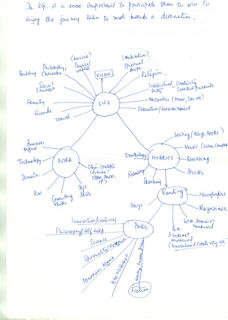
There is an interesting coincidence associated with this exercise of mine. When I began drawing this map, I saw a coffee cup in front of me and the cup had this etched on it – “In life, it is more important to participate than to win. To enjoy the journey than to rush towards a destination”. Well, that will be the guiding light in this endeavour of mine. We can’t forget the pleasures of life (read: journey). We can't always look at the ends and forget the means. Can we?
- a daily/weekly/monthly timetable/planner that takes into consideration everything I want to do
- a clear demarcation between what’s urgent and what’s important and getting rid of the urgent and unavoidable things. understanding the implications of not doing or doing each task and prioritizing based on desired outcomes
- setting aside one day a week (that’s relatively free) at work (mon thru fri) for catching up with a few non-core-work related tasks (reading business magazines, catching up with business material on the net etc)
- look up mintools.com for ideas and tools
- read and use Steven Covey’s book and planning tools respectively
- using the 80:20 rule to understand what those critical 20% tasks are that make up my life
- maintain a daily time log to note where my time’s ‘going’ and act on it if it is undesirable
- ask myself what I really want to do and prioritize based on that
Here’s the mind map I drew.
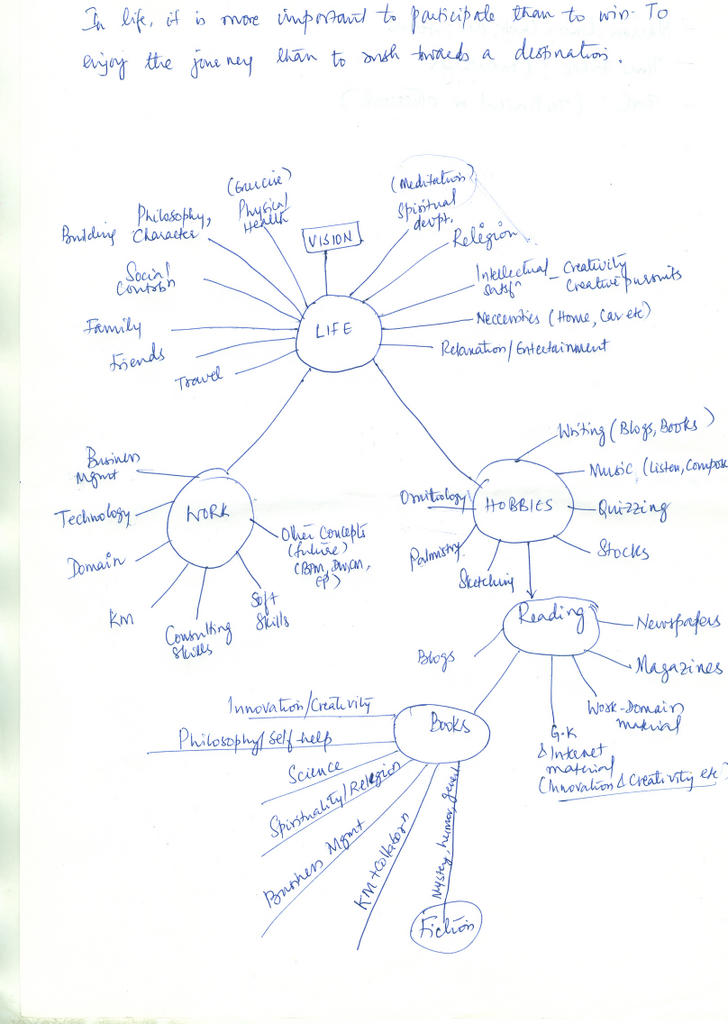
There is an interesting coincidence associated with this exercise of mine. When I began drawing this map, I saw a coffee cup in front of me and the cup had this etched on it – “In life, it is more important to participate than to win. To enjoy the journey than to rush towards a destination”. Well, that will be the guiding light in this endeavour of mine. We can’t forget the pleasures of life (read: journey). We can't always look at the ends and forget the means. Can we?
Monday, September 19, 2005
Blogs for Retailers - Passing Thoughts
I have had this thought for some time now – in the case of service-oriented companies such as retailers, blogs by customer-facing employees who make it a point to talk about their good and bad experiences from which the rest of the organization can learn lessons on customer satisfaction and complaints will be truly useful. Ultimately, a well-defined and designed system will even lead to effective business analytics. Such blogs can of course be subscribed to by employees across the organization and smart subscriptions and tags will help filter the more useful of the posts. Looking at these blogs from the other angle, if these blogs are on the public network and are visited by customers and prospect customers who care to leave their comments and thoughts behind, it will make a huge difference, provided the organization is ready to pick up subtle messages and obvious complaints. The network effect as known in the marketing world can also be put to good work here!!!
Wednesday, September 14, 2005
I gotta learn!!!!!!
A Thought for the Day From Sri Eknath Easwaran
----------------------------------------------
September 12
Each day is a little life; every waking and rising a little birth; every fresh morning a little youth; every going to rest and sleep a little death. - Arthur Schopenhauer
My grandmother, my spiritual teacher, used to tell me that the pain we associate with the great change called death arises from our innumerable selfish attachments. One day she illustrated this in a simple way by asking me to sit in a chair and hold tight to the arms. Then she tried to pull me out of the chair. She tugged and pulled at me, and I held on tight.
It was painful. She was a strong person, and even though I held on with all my strength, she pulled me out. Then she told me to sit down again, but this time not to hold on anywhere just to get up and come to her when she called. With ease I got out of the chair and went to her. This, she told me, is how to overcome the fear and pain of death. When we hold onto things -- houses, cars, books, guitars, our antique silver teapot -- we get attached and tied down.
-------------------------------
I need to learn...esp. when it comes to books....I seem to be obsessed with them and will not even allow members of the insectopedia/reptilia family to trespass into the area in which my book shelf is located...let alone homo sapiens
----------------------------------------------
September 12
Each day is a little life; every waking and rising a little birth; every fresh morning a little youth; every going to rest and sleep a little death. - Arthur Schopenhauer
My grandmother, my spiritual teacher, used to tell me that the pain we associate with the great change called death arises from our innumerable selfish attachments. One day she illustrated this in a simple way by asking me to sit in a chair and hold tight to the arms. Then she tried to pull me out of the chair. She tugged and pulled at me, and I held on tight.
It was painful. She was a strong person, and even though I held on with all my strength, she pulled me out. Then she told me to sit down again, but this time not to hold on anywhere just to get up and come to her when she called. With ease I got out of the chair and went to her. This, she told me, is how to overcome the fear and pain of death. When we hold onto things -- houses, cars, books, guitars, our antique silver teapot -- we get attached and tied down.
-------------------------------
I need to learn...esp. when it comes to books....I seem to be obsessed with them and will not even allow members of the insectopedia/reptilia family to trespass into the area in which my book shelf is located...let alone homo sapiens
Whew....
I've got almost 6-7 posts that are waiting to be completed....whew! My days are packed! : Not finding the time to sit down and finish them....life is chugging along but the ideas are getting 'stored' in a word document....so, there's perhaps no worry of losing the train of thoughts...or is there? Mmmmm? :)
Anyways, here's something (some pictures and a quote) that I had put together last year (and simply loved the final outcome). This one’s just to compensate for the lack of ‘activity’ on my blog; even as I realized that the blog is beginning to look a tad boring without pictures. Good thing I recalled that this one is a great picture to share...what say?
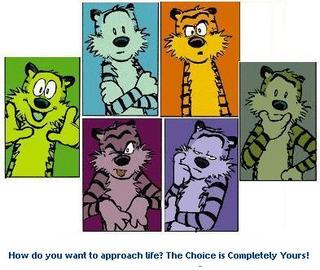
PS: In the next few days, I should be able to hopefully put up a longish article on strategizing and the like, based on a seminar that I attended in office!
UPDATE: The cartoon you see in this post is of course, our lovable, Hobbes...Calvin's pet, best friend and alter ego! The actual context is one where Calvin tries out various goggles and asks Hobbes for his opinion. Hobbes responds with so many different expressions when calvin tries out the goggles... :) I pulled out the various expressions, put them up in one box and thought the quote below (which is my own quote) suits the picture amazingly well. :), Thanks to Bill Watterson for the inspiration! Those who know me also know that I can never stop thanking Bill for the wonderful Calvin n Hobbes stories... :). Thanks to neha for helping me put this post in the right perspective and add this bit to make it a complete one...! :)
Anyways, here's something (some pictures and a quote) that I had put together last year (and simply loved the final outcome). This one’s just to compensate for the lack of ‘activity’ on my blog; even as I realized that the blog is beginning to look a tad boring without pictures. Good thing I recalled that this one is a great picture to share...what say?

PS: In the next few days, I should be able to hopefully put up a longish article on strategizing and the like, based on a seminar that I attended in office!
UPDATE: The cartoon you see in this post is of course, our lovable, Hobbes...Calvin's pet, best friend and alter ego! The actual context is one where Calvin tries out various goggles and asks Hobbes for his opinion. Hobbes responds with so many different expressions when calvin tries out the goggles... :) I pulled out the various expressions, put them up in one box and thought the quote below (which is my own quote) suits the picture amazingly well. :), Thanks to Bill Watterson for the inspiration! Those who know me also know that I can never stop thanking Bill for the wonderful Calvin n Hobbes stories... :). Thanks to neha for helping me put this post in the right perspective and add this bit to make it a complete one...! :)
Tuesday, September 13, 2005
My friend says....The Blog:
Blog(Glob)ing for posers!: "Its the best place to please both your ego and your conscience by giving them a stage to fight :)"
--------
Well said, Sari! :)
--------
Well said, Sari! :)
Monday, September 12, 2005
lessons learned how to build a successful blog
lessons learned how to build a successful blog
A great page to check out what's happening in the world of corporate blogging...
A great page to check out what's happening in the world of corporate blogging...
Leadership - Jim Via Zig
Zig Ziglar Full Newsletter: "The Qualities Of Skillful Leadership
By Jim Rohn
If you want to be a leader who attracts quality people, the key is to become a person of quality yourself. Leadership is the ability to attract someone to the gifts, skills, and opportunities you offer as an owner, as a manager, as a parent. I call leadership the great challenge of life.
What's important in leadership is refining your skills. All great leaders keep working on themselves until they become effective. Here are some specifics:
1. Learn to be strong but not rude. It is an extra step you must take to become a powerful, capable leader with a wide range of reach. Some people mistake rudeness for strength. It's not even a good substitute.
2. Learn to be kind but not weak. We must not mistake kindness for weakness. Kindness isn't weak. Kindness is a certain type of strength. We must be kind enough to tell somebody the truth. We must be kind enough and considerate enough to lay it on the line. We must be kind enough to tell it like it is and not deal in delusion.
3. Learn to be bold but not a bully. It takes boldness to win the day. To build your influence, you've got to walk in front of your group. You've got to be willing to take the first arrow, tackle the first problem, discover the first sign of trouble.
4. You've got to learn to be humble, but not timid. You can't get to the high life by being timid. Some people mistake timidity for humility. Humility is almost a God-like word. A sense of awe. A sense of wonder. An awareness of the human soul and spirit. An understanding that there is something unique about the human drama versus the rest of life. Humility is a grasp of the distance between us and the stars, yet having the feeling that we're part of the stars. So humility is a virtue; but timidity is a disease. Timidity is an affliction. It can be cured, but it is a problem.
5. Be proud but not arrogant. It takes pride to win the day. It takes pride to build your ambition. It takes pride in community. It takes pride in cause, in accomplishment. But the key to becoming a good leader is being proud without being arrogant. In fact, I believe the worst kind of arrogance is arrogance from ignorance. It's when you don't know that you don't know. Now that kind of arrogance is intolerable. If someone is smart and arrogant, we can tolerate that. But if someone is ignorant and arrogant, that's just too much to take.
6. Develop humor without folly. That's important for a leader. In leadership, we learn that it's okay to be witty, but not silly. It's okay to be fun, but not foolish.
7. Lastly, deal in realities. Deal in truth. Save yourself the agony. Just accept life like it is. Life is unique. Some people call it tragic, but I'd like to think it's unique. The whole drama of life is unique. It's fascinating. And I've found that the skills that work well for one leader may not work at all for another. But the fundamental skills of leadership can be adapted to work well for just about everyone: at work, in the community, and at home.
------------------------------------------------
No wonder being a leader is not particulary easy! :-)
By Jim Rohn
If you want to be a leader who attracts quality people, the key is to become a person of quality yourself. Leadership is the ability to attract someone to the gifts, skills, and opportunities you offer as an owner, as a manager, as a parent. I call leadership the great challenge of life.
What's important in leadership is refining your skills. All great leaders keep working on themselves until they become effective. Here are some specifics:
1. Learn to be strong but not rude. It is an extra step you must take to become a powerful, capable leader with a wide range of reach. Some people mistake rudeness for strength. It's not even a good substitute.
2. Learn to be kind but not weak. We must not mistake kindness for weakness. Kindness isn't weak. Kindness is a certain type of strength. We must be kind enough to tell somebody the truth. We must be kind enough and considerate enough to lay it on the line. We must be kind enough to tell it like it is and not deal in delusion.
3. Learn to be bold but not a bully. It takes boldness to win the day. To build your influence, you've got to walk in front of your group. You've got to be willing to take the first arrow, tackle the first problem, discover the first sign of trouble.
4. You've got to learn to be humble, but not timid. You can't get to the high life by being timid. Some people mistake timidity for humility. Humility is almost a God-like word. A sense of awe. A sense of wonder. An awareness of the human soul and spirit. An understanding that there is something unique about the human drama versus the rest of life. Humility is a grasp of the distance between us and the stars, yet having the feeling that we're part of the stars. So humility is a virtue; but timidity is a disease. Timidity is an affliction. It can be cured, but it is a problem.
5. Be proud but not arrogant. It takes pride to win the day. It takes pride to build your ambition. It takes pride in community. It takes pride in cause, in accomplishment. But the key to becoming a good leader is being proud without being arrogant. In fact, I believe the worst kind of arrogance is arrogance from ignorance. It's when you don't know that you don't know. Now that kind of arrogance is intolerable. If someone is smart and arrogant, we can tolerate that. But if someone is ignorant and arrogant, that's just too much to take.
6. Develop humor without folly. That's important for a leader. In leadership, we learn that it's okay to be witty, but not silly. It's okay to be fun, but not foolish.
7. Lastly, deal in realities. Deal in truth. Save yourself the agony. Just accept life like it is. Life is unique. Some people call it tragic, but I'd like to think it's unique. The whole drama of life is unique. It's fascinating. And I've found that the skills that work well for one leader may not work at all for another. But the fundamental skills of leadership can be adapted to work well for just about everyone: at work, in the community, and at home.
------------------------------------------------
No wonder being a leader is not particulary easy! :-)
Some financial advice for women...
Moneycontrol.com - News, 9 money tips for a smart woman - TAX, Personal Finance, Money, Income Tax, mutual funds, insurance, debt, loans
Pretty obvious....but the obvious as they say is often overlooked...
Pretty obvious....but the obvious as they say is often overlooked...
Nice stuff from Eknath!
A Thought for the Day From Sri Eknath Easwaran
----------------------------------------------
Even as a tortoise draws in its limbs, the wise can draw in their senses at will. - Bhagavad Gita
The Gita says a free person can draw in his senses just as a tortoise draws in its legs. What a marvelous simile! Just imagine a tortoise being approached by a group of school children with sticks in their hands. He sees the children coming, and the command is given to the limbs, "Retire!"
Immediately, the head, the tail, and the four legs withdraw into the shell. The children come; they beat out a rhythm on the shell with their sticks. They toss the tortoise in the air, but they can't harm him. After the children leave and all is quiet, the tortoise ventures to stick his neck out, then his tail and legs. He continues his journey, unconcerned. He goes where he likes.
If we want to live in freedom, Krishna says, we must train our senses. We learn when to welcome an experience, and when to withdraw for our own safety. We become masters of our lives. Then we will be like the giant tortoise I saw at the zoo - wandering freely while all the other animals were in cages. A notice on his back read: "I am free. Don't report me to the management."
---------------------------
:-) Lots to learn from all the living beings that we co-exist with!
----------------------------------------------
Even as a tortoise draws in its limbs, the wise can draw in their senses at will. - Bhagavad Gita
The Gita says a free person can draw in his senses just as a tortoise draws in its legs. What a marvelous simile! Just imagine a tortoise being approached by a group of school children with sticks in their hands. He sees the children coming, and the command is given to the limbs, "Retire!"
Immediately, the head, the tail, and the four legs withdraw into the shell. The children come; they beat out a rhythm on the shell with their sticks. They toss the tortoise in the air, but they can't harm him. After the children leave and all is quiet, the tortoise ventures to stick his neck out, then his tail and legs. He continues his journey, unconcerned. He goes where he likes.
If we want to live in freedom, Krishna says, we must train our senses. We learn when to welcome an experience, and when to withdraw for our own safety. We become masters of our lives. Then we will be like the giant tortoise I saw at the zoo - wandering freely while all the other animals were in cages. A notice on his back read: "I am free. Don't report me to the management."
---------------------------
:-) Lots to learn from all the living beings that we co-exist with!
Best Practices! Are they Quick Wins?
Methinks:
In the context of a large organization, sharing best practices is believed to be a quick win in any KM initiative. True. But has anyone thought about how easy or difficult the whole thing is? Is it sufficient if one finds out who is doing something well and share it with people who are in similar situations and grappling with similar objectives? What are the challenges? Do the organizations that attempt to leverage on best practices consider these challenges and spend enough time overcoming or even better preventing them? Does the knowledge shared with a team (which someone else (read: KM champion/business leader) thought would help them) finish the job and achieve those beautiful results for the receiving team and the organization? What about looking into how best practices should be shared and whether the department/team/person with whom it is shared is indeed using it or not? Some of the challenges that need to be considered are as follows:
- the source of knowledge and its (the source’s) reputation – most people will not pick up best practices from a team they consider their rival/a team they don’t respect/a team they don’t technically trust/that has been ‘transferred’ by a middleman they don’t honor etc. thus, a lot depends on the relationship between the person/team giving it and taking it as well as the middle men involved
- the second aspect that will make a difference is the method of knowledge/best practice transfer – something like storytelling would probably have the best results while a dry declaration of something as a best practice minus even the minimum rhetoric, proof, results etc will perhaps not drive home the message. Even worse would be a ‘you do it this way because I say so and I know better’ approach.
- another aspect to consider will be the applicability of the best practice in the new environment. Differences (business, cultural, procedural, technical) in the situations will have to be taken into consideration and may call for customization/change/tweaking of the ‘best’ practice
- lastly, another very important factor to be considered would be the probable presence of the NIH (Not Invented Here) syndrome! If it does exist, then leadership will play a crucial role in combating it.
What do you think?
In the context of a large organization, sharing best practices is believed to be a quick win in any KM initiative. True. But has anyone thought about how easy or difficult the whole thing is? Is it sufficient if one finds out who is doing something well and share it with people who are in similar situations and grappling with similar objectives? What are the challenges? Do the organizations that attempt to leverage on best practices consider these challenges and spend enough time overcoming or even better preventing them? Does the knowledge shared with a team (which someone else (read: KM champion/business leader) thought would help them) finish the job and achieve those beautiful results for the receiving team and the organization? What about looking into how best practices should be shared and whether the department/team/person with whom it is shared is indeed using it or not? Some of the challenges that need to be considered are as follows:
- the source of knowledge and its (the source’s) reputation – most people will not pick up best practices from a team they consider their rival/a team they don’t respect/a team they don’t technically trust/that has been ‘transferred’ by a middleman they don’t honor etc. thus, a lot depends on the relationship between the person/team giving it and taking it as well as the middle men involved
- the second aspect that will make a difference is the method of knowledge/best practice transfer – something like storytelling would probably have the best results while a dry declaration of something as a best practice minus even the minimum rhetoric, proof, results etc will perhaps not drive home the message. Even worse would be a ‘you do it this way because I say so and I know better’ approach.
- another aspect to consider will be the applicability of the best practice in the new environment. Differences (business, cultural, procedural, technical) in the situations will have to be taken into consideration and may call for customization/change/tweaking of the ‘best’ practice
- lastly, another very important factor to be considered would be the probable presence of the NIH (Not Invented Here) syndrome! If it does exist, then leadership will play a crucial role in combating it.
What do you think?
Tuesday, September 06, 2005
Do you fit life's bill?
When life goes uphill
Just chill chill, just chill !
And, when it goes downhill,
Remember that it is but a sweet pill !
Life can never ever kill...
If you fit its bill !
And that’s to be still...
Come sorrow, come thrill !
One never ought to (mentally) feel ill ,
For, giving in can, in the heart, bore a drill !
If only one strives to till...
And bring up an iron will,
Adverse effects on one is simply NIL !
(c) Nimmy :) (inspired by one of these lines - just chill chill, just chill - that appears in a recent Hindi movie song)
Just chill chill, just chill !
And, when it goes downhill,
Remember that it is but a sweet pill !
Life can never ever kill...
If you fit its bill !
And that’s to be still...
Come sorrow, come thrill !
One never ought to (mentally) feel ill ,
For, giving in can, in the heart, bore a drill !
If only one strives to till...
And bring up an iron will,
Adverse effects on one is simply NIL !
(c) Nimmy :) (inspired by one of these lines - just chill chill, just chill - that appears in a recent Hindi movie song)
Monday, September 05, 2005
Blog Checking...1,2,3...
Okay. It’s time I did this. A reality check. Courtesy: Raj. I was running through Raj’s blog and read this post where he says he decided to remove one of the topics mentioned under his blog title that he had initially thought he might harp about but eventually ended up sort of ignoring. When I created my blog more than a year ago, I decided that I’d mention all the subjects that I am interested in because I knew I’d be inclined to talk about them at one time or the other. Even though there were previous occasions when I had looked at my blog and felt that I’d mentioned so many areas of interest that it would have been practically difficult for anyone, let alone me, to do justice to all of them. I’ve touched upon all the topics that I’ve mentioned under my blog title, but then, that’s in no way good enough to warrant a subscription by a person obsessed with, say, an area that is “almost-ignored”/”less-spoken-about” by me.
Okay…so, what did I say I’d be talking about on my blog?
The Subjects - Life, Spirituality, Knowledge Management (KM), Creativity, Innovation, Leadership, Branding & Advertising, Books, People, Learning, Music, Poetry, Animals, Birds, Philosophy, Mysticism, Paradoxes, Comics, Change Management, Culture, Travel, and Cartoons
And what do I really talk about more often than not? Under-promise and over-deliver is the mantra these days. [Which reminds me….I watched a recent interview of CNBC with Narayan Murthy and Nandan Nilekani - hosted by Shreen Bhan (smart lady, this one…right?). And while on the topic of ethics, and organizations following a passion/ideal rather than making money, I’d like to recount what Nandan said in this interview….”….we followed our passion and just happened to make some money on the way….”. I don’t know if it was a put on, but assuming it was 100% real, I love that attitude.]
Okay…..rewind…..so going by the under-promise mantra, let me see what I talk about more often than the rest….maybe I should actually leverage on the situation and also use it to narrow down my focus to a few areas…[Will someone stand up and knock some sense into my head please? How do I concentrate on a maximum of one/two things? Sigh!]
Going by my current ‘phase’ - I often talk about the following:
- life, spirituality, KM, philosophy
I occasionally talk about:
- creativity, innovation, leadership, branding, paradoxes, books, people
I don’t so often talk about:
- poetry, change management, culture, travel, cartoons, learning, music, animals, birds, mysticism, comics etc
Reality check done! Roger out! Blog subtitles shall be corrected for now! :)
-------------------------
And…..this exercise has prompted me to do another reality check exercise of sorts. That of stock-taking of my life! What do I want to do? What am I doing? What do I need to change to get on to the right track/walk faster? But that’s another post….
I would have digressed too much had I spoken about this while recounting Nandan’s statement. Now that I’ve said everything I wanted to about my original post, let me also talk about another Infy philosophy which if followed in reality will be a great thing– “Debate, Ideate and Implement”. I thought it was a very nice and simple philosophy that reflects KM in its heart (head?) as regards the first step – that of debating…
Okay…so, what did I say I’d be talking about on my blog?
The Subjects - Life, Spirituality, Knowledge Management (KM), Creativity, Innovation, Leadership, Branding & Advertising, Books, People, Learning, Music, Poetry, Animals, Birds, Philosophy, Mysticism, Paradoxes, Comics, Change Management, Culture, Travel, and Cartoons
And what do I really talk about more often than not? Under-promise and over-deliver is the mantra these days. [Which reminds me….I watched a recent interview of CNBC with Narayan Murthy and Nandan Nilekani - hosted by Shreen Bhan (smart lady, this one…right?). And while on the topic of ethics, and organizations following a passion/ideal rather than making money, I’d like to recount what Nandan said in this interview….”….we followed our passion and just happened to make some money on the way….”. I don’t know if it was a put on, but assuming it was 100% real, I love that attitude.]
Okay…..rewind…..so going by the under-promise mantra, let me see what I talk about more often than the rest….maybe I should actually leverage on the situation and also use it to narrow down my focus to a few areas…[Will someone stand up and knock some sense into my head please? How do I concentrate on a maximum of one/two things? Sigh!]
Going by my current ‘phase’ - I often talk about the following:
- life, spirituality, KM, philosophy
I occasionally talk about:
- creativity, innovation, leadership, branding, paradoxes, books, people
I don’t so often talk about:
- poetry, change management, culture, travel, cartoons, learning, music, animals, birds, mysticism, comics etc
Reality check done! Roger out! Blog subtitles shall be corrected for now! :)
-------------------------
And…..this exercise has prompted me to do another reality check exercise of sorts. That of stock-taking of my life! What do I want to do? What am I doing? What do I need to change to get on to the right track/walk faster? But that’s another post….
I would have digressed too much had I spoken about this while recounting Nandan’s statement. Now that I’ve said everything I wanted to about my original post, let me also talk about another Infy philosophy which if followed in reality will be a great thing– “Debate, Ideate and Implement”. I thought it was a very nice and simple philosophy that reflects KM in its heart (head?) as regards the first step – that of debating…
Dancing to the tune of iTunes
I happened to come across iTunes – the music player from Apple; the counterpart of Windows Media player - and downloaded it just to get a feel of an Apple product. Ummm, there are almost similar in terms of the features, but of course, have very different looking UIs. But, the thing to note is that while the new windows media player is pretty smart when minimized (there is a quick access bar that embeds itself in the regular windows task bar – the benefits of being a vendor with multiple products), iTunes does no such special thing…..
But, here’s my core message - I am completely enthralled by the iTunes’ visualization. It is absolutely cool! It seems to have an almost infinite number of permutations and combinations and is soothing to one’s eyes and can get one’s creative juices flowing! (Whereas the windows media player has a finite and limited, and boring I ought to add, number of options when it comes to visualization…)
But, here’s my core message - I am completely enthralled by the iTunes’ visualization. It is absolutely cool! It seems to have an almost infinite number of permutations and combinations and is soothing to one’s eyes and can get one’s creative juices flowing! (Whereas the windows media player has a finite and limited, and boring I ought to add, number of options when it comes to visualization…)
Tuesday, August 30, 2005
Discovering the Universe!
Saw this prg. on TV - Discovery- last weekend! It was absolutely Fantastic! Search for "Elegant Universe" + "Einstein's Dream" on Google and log into Discovery Online...I'll try and post more links later...no time to value-add now.. :(
Okay! Here's an update - I bought the book "The elegant universe" by Brian Greene the day before! It is all about man's quest to unify the theory of gravity, electromagnetism and the nuclear forces into one theory dubbed as the theory of everything/string theory/M theory....interesting stuff if you love physics/want to know more about our universe and where it began...
Okay! Here's an update - I bought the book "The elegant universe" by Brian Greene the day before! It is all about man's quest to unify the theory of gravity, electromagnetism and the nuclear forces into one theory dubbed as the theory of everything/string theory/M theory....interesting stuff if you love physics/want to know more about our universe and where it began...
Kerala's Akshaya project wins global IT award- The Economic Times
Why can't the other states in India learn from Kerala? Why aren't we making use of the concepts of Knowledge Sharing and Collaboration? Why doesn't the central government wield the stick and make it happen? Oh, God! I want to see India transform into the 'best' country on earth overnight...or at least maybe before I die...(which is hopefully not overnight! ) ;-)
Monday, August 29, 2005
Of conversations and their entertainment value...
Caveat: There's nothing profound about this post. And you may not even find it as funny as I did. It's just a conversation...reported on a blog. For variety's sake you may think...And don't ask me how I remembered the coversation down to the Ho...it's only an approximate reconstruction, that's all :)
A couple of days ago, I had a meeting to attend during my regular lunch time and therefore asked my lunch-friends to carry on for lunch without me. I finished the meeting and went in for a quick bite as I had to come back for another meeting in less than 20 minutes. Once in the lunch room, I jumped on to the nearest vacant seat where 2 guys were almost through with their lunch. They were having a conversation in Tamil. Of course, given that I understand Tamil and was very much within earshot, I’d forcibly ‘joined’ the conversation. (What do you do in such cases? It is something of an ethical dilemma. You don’t want to eavesdrop, you can’t you plug your ears, or even tell them “hey, stop talking…I am here and understand what you’re talking, so if it’s anything personal, you may want to wait till you’re alone”). So I just went about my business of eating and was in for some 'entertainment'! They were obviously in the middle of a conversation but it was one that could be ‘joined’ by anyone anytime. (Following is a rough (especially the laughter) narration of what transpired between the 2 aforementioned people,. Ha ha hee hee. :-) And, of course, the conversation has been translated into English for everyone’s benefit)
First Guy: “So, he hasn’t mentioned it to his organization?”
Second Guy: “Yes”
First Guy: “Is there a rule or something that people who join XYZ (he named an IT organization) are not supposed to get married for the first one year? Is there a bond to that effect? Ha ha ho ho”
Second Guy: “Ha ha ho ho ho ho”
{pause}
Second Guy: “Actually, the students who join organizations from Campus will want a job so badly that they might even agree if the organization instructs them to remain unmarried for life! Ha ha ha ho ho”
First Guy: “Haaaa ha ho ho ho ha”
{pause}
First Guy: “So, what’s happening? You’ve told your parents?”
Second Guy: “mmmm,…………..she’s asking me if I’ve traveled abroad, if I’ve traveled to the USA, if I have a H1B Visa!”
First Guy: “Don’t tell me! They even ask you if you’ve got a H1B Visa? Ridiculous”
Second Guy:”Yes, it’s really crazy! Looks like they’ll get married to anyone who has a H1B Visa….even if there’s nothing else!”
{long pause leading to a change of topic}
First Guy: “You know these companies, when they interview candidates, they decide on the compensation based on the behaviour! If you respect the interviewers, they assume that you are ignorant and ask you to settle for something less. If you’re arrogant and don’t respect them…say sit in an arrogant posture or something…they immediately assume that you know a lot and offer you a better pay packet!”
First Guy (again): “What kind of a policy (attitude?) is it? It is something that the company is using to belittle itself…something that the company follows to make itself look ugly!”
First Guy and Second Guy: Ha ha haaa ha ha ho ho
__________________
:-) That’s all folks! (Yours truly made her exit at this point)
A couple of days ago, I had a meeting to attend during my regular lunch time and therefore asked my lunch-friends to carry on for lunch without me. I finished the meeting and went in for a quick bite as I had to come back for another meeting in less than 20 minutes. Once in the lunch room, I jumped on to the nearest vacant seat where 2 guys were almost through with their lunch. They were having a conversation in Tamil. Of course, given that I understand Tamil and was very much within earshot, I’d forcibly ‘joined’ the conversation. (What do you do in such cases? It is something of an ethical dilemma. You don’t want to eavesdrop, you can’t you plug your ears, or even tell them “hey, stop talking…I am here and understand what you’re talking, so if it’s anything personal, you may want to wait till you’re alone”). So I just went about my business of eating and was in for some 'entertainment'! They were obviously in the middle of a conversation but it was one that could be ‘joined’ by anyone anytime. (Following is a rough (especially the laughter) narration of what transpired between the 2 aforementioned people,. Ha ha hee hee. :-) And, of course, the conversation has been translated into English for everyone’s benefit)
First Guy: “So, he hasn’t mentioned it to his organization?”
Second Guy: “Yes”
First Guy: “Is there a rule or something that people who join XYZ (he named an IT organization) are not supposed to get married for the first one year? Is there a bond to that effect? Ha ha ho ho”
Second Guy: “Ha ha ho ho ho ho”
{pause}
Second Guy: “Actually, the students who join organizations from Campus will want a job so badly that they might even agree if the organization instructs them to remain unmarried for life! Ha ha ha ho ho”
First Guy: “Haaaa ha ho ho ho ha”
{pause}
First Guy: “So, what’s happening? You’ve told your parents?”
Second Guy: “mmmm,…………..she’s asking me if I’ve traveled abroad, if I’ve traveled to the USA, if I have a H1B Visa!”
First Guy: “Don’t tell me! They even ask you if you’ve got a H1B Visa? Ridiculous”
Second Guy:”Yes, it’s really crazy! Looks like they’ll get married to anyone who has a H1B Visa….even if there’s nothing else!”
{long pause leading to a change of topic}
First Guy: “You know these companies, when they interview candidates, they decide on the compensation based on the behaviour! If you respect the interviewers, they assume that you are ignorant and ask you to settle for something less. If you’re arrogant and don’t respect them…say sit in an arrogant posture or something…they immediately assume that you know a lot and offer you a better pay packet!”
First Guy (again): “What kind of a policy (attitude?) is it? It is something that the company is using to belittle itself…something that the company follows to make itself look ugly!”
First Guy and Second Guy: Ha ha haaa ha ha ho ho
__________________
:-) That’s all folks! (Yours truly made her exit at this point)
Business without ethics...
Did you know this? (Saw it on a programme on Richard Branson in the History Channel)
British Airways felt threatened by Virgin Atlantic when the latter captured a huge pie of the sky and went on what is apparently known as the ‘Dirty Tricks Campaign’ at Virgin Atlantic. The campaign was about spreading false stories about Virgin – posing as Virgin to tell customers that flights were cancelled, and stealing information! I was shocked! Talk about Business without ethics! BA also paid close to $1 Mill as settlement (I don’t know if it was outside the court). It takes me back to my previous post about organizations not chasing money but an ideal…
British Airways felt threatened by Virgin Atlantic when the latter captured a huge pie of the sky and went on what is apparently known as the ‘Dirty Tricks Campaign’ at Virgin Atlantic. The campaign was about spreading false stories about Virgin – posing as Virgin to tell customers that flights were cancelled, and stealing information! I was shocked! Talk about Business without ethics! BA also paid close to $1 Mill as settlement (I don’t know if it was outside the court). It takes me back to my previous post about organizations not chasing money but an ideal…
Sunday, August 28, 2005
Motivation - Money or Passion?
Q. Money, position and power have limited scope in sustaining a high level of motivation. Then from where should the source of motivation stem from?
Ans. It must stem from a conviction or ideal that is deeply and strongly embedded in our heart. This makes it easy for the individual to dedicate any results and sense of being the doer at the alter of one's ideal or conviction. The institution's interest must be the uppermost objective, overriding the individual's ego. Then, the ideal will bring glory to the institution, society or nation. It is this attitude which has caused great achievements in the fields of science, history, art, literature,engineering and others. Great persons effortlessly spent lifetimes in serving their chosen ideal, and as a result, served society at large by their dedicated work and inspired actions. Ideals and convictions are powerful motivational sources when aligned with an organisation's values.
- R.K. Srinivasa Murthy
_______________________________________
I think the world would be a great place to live in if organizations stopped chasing money and instead focused on making the world a better place to live in...if they started focusing on their passion...I've a lot more to say on this topic. I shall come back....
Ans. It must stem from a conviction or ideal that is deeply and strongly embedded in our heart. This makes it easy for the individual to dedicate any results and sense of being the doer at the alter of one's ideal or conviction. The institution's interest must be the uppermost objective, overriding the individual's ego. Then, the ideal will bring glory to the institution, society or nation. It is this attitude which has caused great achievements in the fields of science, history, art, literature,engineering and others. Great persons effortlessly spent lifetimes in serving their chosen ideal, and as a result, served society at large by their dedicated work and inspired actions. Ideals and convictions are powerful motivational sources when aligned with an organisation's values.
- R.K. Srinivasa Murthy
_______________________________________
I think the world would be a great place to live in if organizations stopped chasing money and instead focused on making the world a better place to live in...if they started focusing on their passion...I've a lot more to say on this topic. I shall come back....
Friday, August 26, 2005
Mr.AB!
Big B, Amitabh Bachchan, is a man that I admire a lot. I have not really been influenced so much by his acting skills or his movies as much as his character. Though there are some movies of his which I’ve enjoyed immensely and I thought his characterization and performance were particularly good in Sholay, Chupke Chupke, Anand and Satte Pe Satta. (Note that I am not a movie buff and haven’t watched all his movies. There may be better movies of his which I’ve missed). What I like him for and what I am enamored by is that he’s a guy who seems to blend sophistication and simplicity with so much ease that it is almost unbelievable. He has an air of dignity and humility, all at the same time! He’s a bundle of nicely amalgamated paradoxes. And, methinks, that’s so difficult to achieve!
Maybe, I’ve posted this before, but I wouldn’t mind saying it again - The first time I was actually impressed was when he said this about his son, Abhishek Bachchan, when asked by an interviewer as to whether he was worried about Abhishek’s image of being a silent and ‘unaware’ person - “I’d rather my son be an ignorant (read ‘a person who doesn’t understand politics’) person than a cheap and cunning fellow!” To add to this, it is inspiring to realize that he is now living his second life or perhaps third life after the famous freak fire accident earlier in his career and of course his well-known losses in business, after an interim retirement from acting, a decade or so ago. It’s amazing how nature has rewarded him for his patience and resilience by getting Bollywood to actually create new movies FOR him - REVOLVING around a man his age and makeup, when there are so many young heroes struggling to make a mark! Life is wonderful and stunning in its methods!
Maybe, I’ve posted this before, but I wouldn’t mind saying it again - The first time I was actually impressed was when he said this about his son, Abhishek Bachchan, when asked by an interviewer as to whether he was worried about Abhishek’s image of being a silent and ‘unaware’ person - “I’d rather my son be an ignorant (read ‘a person who doesn’t understand politics’) person than a cheap and cunning fellow!” To add to this, it is inspiring to realize that he is now living his second life or perhaps third life after the famous freak fire accident earlier in his career and of course his well-known losses in business, after an interim retirement from acting, a decade or so ago. It’s amazing how nature has rewarded him for his patience and resilience by getting Bollywood to actually create new movies FOR him - REVOLVING around a man his age and makeup, when there are so many young heroes struggling to make a mark! Life is wonderful and stunning in its methods!
A great advt.!
Have you seen this new ad on TV for Surf Excel? It was telecast, I think, for the very first time on the eve of Raksha Bandhan. I should say that the ad has bowled me over completely. The kids, the concept, the expressions….everything about it is cute! Kudos to the people who conceptualized the whole thing and to the folks who picked the children out from GOD knows where and got them to act it out so well! I was contemplating narrating the ad on this post, but no, on second thoughts, I decided I ought not to deprive you of the pleasure of watching the original on TV and experiencing it first hand! :). Don’t please miss it; especially if you are either a loving sibling or for that matter a loving parent.
Wednesday, August 24, 2005
Live Music...on the move
It feels pretty nice to think about how some folks make all the difference to people around them by doing their bit, however small a thing it may be. When I worked with an IT organization in Chennai a few years ago, I used to commute between Purasaivakkam and Egmore everyday. The bus that I used to take was so crowded that it seemed more like we were ‘moving’ the vehicle rather than the other way round. There was a bunch of youngsters –regulars – that traveled on the footboard and dangled on to the bus by (I often think) their nails. Amongst these youngsters were 3 boys who used to sing hit songs from the latest Tamil movies and sometimes add to it an oldie as well! They were loud enough for everyone in the bus to hear and the sound waves reached us folks in the front through the air outside the bus…uncontaminated by the cacophony (if any) inside the bus. It was pretty entertaining because the prerequisites were all in place - The singers had good voices and perhaps some ‘technical’ training as well. Some people in the bus did give them a lukewarm response, perhaps because they were more surprised than entertained and maybe had their share of problems that prevented them from enjoying music. But some of us just loved the entertainment as it made up for lack of radio in the city bus. It was like our very own Top 3 countdown while on the move. :) I am sure it brightened many people’s days and helped them start the day with a (musical) bang.
Monday, August 22, 2005
Culture and Knowledge Management
I’ve been pondering over KM as related to the organizational culture once again... Knowledge Management is only for people and organizations that think long-term and are non self-centered (couldn’t think of a better term!). It’s only for people who look beyond the obvious. There is an inherent happiness in sharing knowledge which extremely self-centered/insecure/’once bitten twice shy’ people find it difficult to see. Knowledge sharing is actually a process of learning – one involving the consolidation of thoughts. If the person learning from one is a novice, the questions that one faces are sufficient to add to one’s knowledge and also to revisit the fundamentals. If the person listening to one is an expert, then the challenges that she poses are once again sufficient for one to keep learning and discovering newer things.
But one still has to be alert. We ought not to give knowledge away to people (read blood-sucking parasites) that don’t deserve it, people whose purpose is to simply get it out of you and make their way up by stepping on your corpse. (How certain people live so happily in such a crematorium beats me) For which we need to also be a good judge of character and objective. Well, the spiritualist in me reminds me about being kind to one’s enemies as well, but in today’s cut-throat/dog-eat-dog world, it doesn’t seem to make sense to knowingly walk into a trap. Needless to say, the organization will have to follow its KM policies in word and spirit. Lack of reinforcement and recognition of the person who shared his knowledge can be a disaster. If the organizational policies and systems let people who’ve taken advantage of knowledge sharing practices to build corner offices for themselves thrive, there is no way in which KM will be a success in the organization. KM is only for organizations where people give credit to the mentors and build teams rather than pursue selfish-objectives. If the manager wants a great team rather than a ‘team’ of individuals good at only their own things, she needs to reward team-players and not individuals who’ve either built their empires on corpses or those who’ve built their empires without a care for the higher purpose.
But one still has to be alert. We ought not to give knowledge away to people (read blood-sucking parasites) that don’t deserve it, people whose purpose is to simply get it out of you and make their way up by stepping on your corpse. (How certain people live so happily in such a crematorium beats me) For which we need to also be a good judge of character and objective. Well, the spiritualist in me reminds me about being kind to one’s enemies as well, but in today’s cut-throat/dog-eat-dog world, it doesn’t seem to make sense to knowingly walk into a trap. Needless to say, the organization will have to follow its KM policies in word and spirit. Lack of reinforcement and recognition of the person who shared his knowledge can be a disaster. If the organizational policies and systems let people who’ve taken advantage of knowledge sharing practices to build corner offices for themselves thrive, there is no way in which KM will be a success in the organization. KM is only for organizations where people give credit to the mentors and build teams rather than pursue selfish-objectives. If the manager wants a great team rather than a ‘team’ of individuals good at only their own things, she needs to reward team-players and not individuals who’ve either built their empires on corpses or those who’ve built their empires without a care for the higher purpose.
Innocence!
‘STOP BEING INNOCENT’ – was a feedback that I got from one of my ex-team members. Though, unfortunately, I don’t really think I am as innocent as I was when I was a kid, ‘you don’t know what you are asking for’, was how I reacted within myself. Ignorance may not really be bliss at all times. But innocence, I think, is. At all times.
Innocence is bliss and more. It is happiness. It is satisfaction. It is learning. It is peace. It is joy. It is intrinsic; the natural state of man. Innocence is GOD. All of us have come away from our natural states…and maybe not for the better. We have lost our innocence and instead substituted it with manipulation, cunningness, Machiavellianism, selfishness, cruelty and what not. One reason why the ‘grown-up’ man talks about learning from children is the fact that they have something that we don’t - innocence. The face of the baby on my blog perhaps says it all.
Innocence is bliss and more. It is happiness. It is satisfaction. It is learning. It is peace. It is joy. It is intrinsic; the natural state of man. Innocence is GOD. All of us have come away from our natural states…and maybe not for the better. We have lost our innocence and instead substituted it with manipulation, cunningness, Machiavellianism, selfishness, cruelty and what not. One reason why the ‘grown-up’ man talks about learning from children is the fact that they have something that we don’t - innocence. The face of the baby on my blog perhaps says it all.
Another of Calvin's (Hobbes') philosophical pieces...
Apart from the substance in this cartoon strip, the pictures have come out very well too! The first box looks awesome....and not to forget the portion where Calvin has been 'circled'...where the message perhaps hits him hard!! :)
Thursday, August 18, 2005
Calvin's View of the World... :)

Another of those profound quips from Calvin....(read Bill W).
I own almost all the P.G.Wodehouse books that are available for sale in India, which works out to be close to 80% of the total number of books (91)written by the comical genius . My eyes are now set on C&H. Got only 3 of them so far...
PS: If you're thinking of giving me any gifts, you know what to buy... ;-)
Sunday, August 14, 2005
Friday, August 12, 2005
A Sudden Change!
Something that happened to me this morning makes me feel a little disorientated about the changes I am going through...
I normally break down when I see a dying/dead dog (not to mention other animals and birds). My eyes start welling up with unrestrained tears and I cry like a baby. More so when the dog has met his/her end because of being run down by a vehicle (driven by a cruel and merciless rogue, I ought to add. GRRRRR!). I am not even able to type this out, feels like I am committing a crime….
This morning, I had the misfortune of laying my eyes on one such gruesome spectacle. But, it was all over when I saw it. I only saw the ‘signs’ of it. (God!). I was almost about to break down when I heard a stern voice in my head. “It’s just the body!” It was as if someone had brought my emotions to a screeching halt. That was not all. As I realized that I’d actually recovered from my emotions in less than a minute, the voice returned to say “Remember, nothing is permanent!” If there were any emotions left in my heart, even they were wiped clean at that instance. I returned to my book. But, as I began to read, I couldn’t help wondering whether I ought to feel good about being detached or feel bad about taking the death of a dog so lightly...almost indicating a lack of humanity/compassion. Any answers?! Please be generous with your thoughts. I want them thoughts! (But I have to admit that I found it challenging to write the first part of this post despite such ‘spiritual developments’ indicating that it may be the transitional phase)
I normally break down when I see a dying/dead dog (not to mention other animals and birds). My eyes start welling up with unrestrained tears and I cry like a baby. More so when the dog has met his/her end because of being run down by a vehicle (driven by a cruel and merciless rogue, I ought to add. GRRRRR!). I am not even able to type this out, feels like I am committing a crime….
This morning, I had the misfortune of laying my eyes on one such gruesome spectacle. But, it was all over when I saw it. I only saw the ‘signs’ of it. (God!). I was almost about to break down when I heard a stern voice in my head. “It’s just the body!” It was as if someone had brought my emotions to a screeching halt. That was not all. As I realized that I’d actually recovered from my emotions in less than a minute, the voice returned to say “Remember, nothing is permanent!” If there were any emotions left in my heart, even they were wiped clean at that instance. I returned to my book. But, as I began to read, I couldn’t help wondering whether I ought to feel good about being detached or feel bad about taking the death of a dog so lightly...almost indicating a lack of humanity/compassion. Any answers?! Please be generous with your thoughts. I want them thoughts! (But I have to admit that I found it challenging to write the first part of this post despite such ‘spiritual developments’ indicating that it may be the transitional phase)
Thursday, August 11, 2005
Wednesday, August 10, 2005
Legacy
Yesterday, I went home to find an old, brownish and slightly tattered book on my bed. I pounced upon it and gingerly flipped through the pages. (Doesn’t that sound like an oxymoron?). The book I found on my bed and gingerly flipped through - “Heroes who made history”. (It’s a book with a dozen chapters covering a dozen Indian Heroes…mostly kings/princes and the like) The author who wrote the book that I found on my bed and gingerly flipped through – V.B. Kulkarni.
V.B. Kulkarni was the then editor of the now Indian Express which was then called the National Standard. (What a sentence! But I like to ‘complicate’ sentences as much as possible…after all I need to justify being one of PLUM’s * biggest fans!) My mom got it as a prize for having stood first in her village school (lower primary school). :). How cute! But she never touched the book because she studied in a Tamil medium school and found it difficult to read books in English. She did have English as a subject but the standard was too ‘simple’ for her to read books and moreover she was too young and playful to read such ‘outside-the-school-syllabus’ books, I guess. (If you don’t find me blogging anymore, you’ll know my mom has been reading my blog ;-) )
* P.G. Wodehouse is known as PLUM to his fans. If you don't know who P.G.Wodehouse is, then I suggest that you do one of the following. (You have lots of options to choose from). Hang yourself with a rugged rope after ensuring that the door to your room is locked from inside/go away to a place that doesn't have any hospitals whatever and consume the deadliest of poisons/ jump from the tallest building in your city/shoot yourself at point-blank range with a gun that cannot fail/stand in the middle of a busy road when the traffic is at its peak....
V.B. Kulkarni was the then editor of the now Indian Express which was then called the National Standard. (What a sentence! But I like to ‘complicate’ sentences as much as possible…after all I need to justify being one of PLUM’s * biggest fans!) My mom got it as a prize for having stood first in her village school (lower primary school). :). How cute! But she never touched the book because she studied in a Tamil medium school and found it difficult to read books in English. She did have English as a subject but the standard was too ‘simple’ for her to read books and moreover she was too young and playful to read such ‘outside-the-school-syllabus’ books, I guess. (If you don’t find me blogging anymore, you’ll know my mom has been reading my blog ;-) )
* P.G. Wodehouse is known as PLUM to his fans. If you don't know who P.G.Wodehouse is, then I suggest that you do one of the following. (You have lots of options to choose from). Hang yourself with a rugged rope after ensuring that the door to your room is locked from inside/go away to a place that doesn't have any hospitals whatever and consume the deadliest of poisons/ jump from the tallest building in your city/shoot yourself at point-blank range with a gun that cannot fail/stand in the middle of a busy road when the traffic is at its peak....
Inspiring Speech by Jim Rohn!
Zig Ziglar Full Newsletter: "Training Lesson:
Bringing Life, Happiness & Joy To Our Lives
By Jim Rohn
Any day we wish, we can discipline ourselves to change it all. Any day we wish, we can open the book that will open our mind to new knowledge. Any day we wish, we can start a new activity. Any day we wish, we can start the process of life change. We can do it immediately, or next week, or next month, or next year.
We can also do nothing. We can pretend rather than perform. And if the idea of having to change ourselves makes us uncomfortable, we can remain as we are. We can choose rest over labor, entertainment over education, delusion over truth, and doubt over confidence. The choices are ours to make. But while we curse the effect, we continue to nourish the cause. As Shakespeare uniquely observed, 'The fault is not in the stars, but in ourselves.' We created our circumstances by our past choices. We have both the ability and the responsibility to make better choices beginning today. Those who are in search of the good life do not need more answers or more time to think things over to reach better conclusions. They need the truth. They need the whole truth. And they need nothing but the truth.
We cannot allow our errors in judgment, repeated every day, to lead us down the wrong path. We must keep coming back to those basics that make the biggest difference in how our life works out. And then we must make the very choices that will bring life, happiness and joy into our daily lives.
And if I may be so bold to offer my last piece of advice for someone seeking and needing to make changes in their life--if you don't like how things are, change it! You're not a tree. You have the ability to totally transform every area in your life--and it all begins with your very own power of choice.
Bringing Life, Happiness & Joy To Our Lives
By Jim Rohn
Any day we wish, we can discipline ourselves to change it all. Any day we wish, we can open the book that will open our mind to new knowledge. Any day we wish, we can start a new activity. Any day we wish, we can start the process of life change. We can do it immediately, or next week, or next month, or next year.
We can also do nothing. We can pretend rather than perform. And if the idea of having to change ourselves makes us uncomfortable, we can remain as we are. We can choose rest over labor, entertainment over education, delusion over truth, and doubt over confidence. The choices are ours to make. But while we curse the effect, we continue to nourish the cause. As Shakespeare uniquely observed, 'The fault is not in the stars, but in ourselves.' We created our circumstances by our past choices. We have both the ability and the responsibility to make better choices beginning today. Those who are in search of the good life do not need more answers or more time to think things over to reach better conclusions. They need the truth. They need the whole truth. And they need nothing but the truth.
We cannot allow our errors in judgment, repeated every day, to lead us down the wrong path. We must keep coming back to those basics that make the biggest difference in how our life works out. And then we must make the very choices that will bring life, happiness and joy into our daily lives.
And if I may be so bold to offer my last piece of advice for someone seeking and needing to make changes in their life--if you don't like how things are, change it! You're not a tree. You have the ability to totally transform every area in your life--and it all begins with your very own power of choice.
Fast Company Now - Focus
Fast Company Now:
Expand Your Focus: 4 Tips
Expanding your focus is one of the most valuable aspects of developing your personal brilliance. When what you are doing is the same as what you are thinking, you are present and focused. In this state of mind, you have a feeling of mental smoothness, even when there's a lot happening.
1. Broaden Your View
Consider the big picture with all of its components and possibilities.
2. Look Beneath the Surface
Appearances can be deceiving. Take a closer look.
3. Practice Being Present
When your mind wanders into the past or future, gently bring it back to 'now.'
4. Observe with Flexible Intent
Be clear about what you are looking for in each situation and simultaneously be open to learning something entirely different."
-------------------------------------------------------
Wait, I am not being paid by FC Now to post all these articles/tidbits... :)
I think these are very useful....and remember, we use blogs to keep track of ideas and learnings as well....so, this is just a matter of recording what I've learned today... :)
I think the list on Curiosity is the coolest of the lot! (scroll down) What say you?
Expand Your Focus: 4 Tips
Expanding your focus is one of the most valuable aspects of developing your personal brilliance. When what you are doing is the same as what you are thinking, you are present and focused. In this state of mind, you have a feeling of mental smoothness, even when there's a lot happening.
1. Broaden Your View
Consider the big picture with all of its components and possibilities.
2. Look Beneath the Surface
Appearances can be deceiving. Take a closer look.
3. Practice Being Present
When your mind wanders into the past or future, gently bring it back to 'now.'
4. Observe with Flexible Intent
Be clear about what you are looking for in each situation and simultaneously be open to learning something entirely different."
-------------------------------------------------------
Wait, I am not being paid by FC Now to post all these articles/tidbits... :)
I think these are very useful....and remember, we use blogs to keep track of ideas and learnings as well....so, this is just a matter of recording what I've learned today... :)
I think the list on Curiosity is the coolest of the lot! (scroll down) What say you?
Fast Company Now - Curiosity
Fast Company Now:
"Curiosity Key to Personal Brilliance 7 Tips
Curiosity helps you clarify problems, ideas, and situations, and it encourages you to explore how they could be different. Actively exploring the environment, asking questions, investigating possibilities, and possessing a sense of wonder are all part of being curious. Questions are key. Once you open up to the nuances of life, it's easy to find things that fascinate you and to begin wondering 'why?' and 'how?'
1. Think Like A Child
2. Look Beyond the Obvious
3. Fire Your Inner Critic
4. Vary Your Daily Routine
5. Identify the Most Impossible Solutions
6. Work Like a Detective
7. Try New Things
1. Think Like A Child
Children are like miniature reporters, constantly asking who, what, when, where, and particularly why. They also have very few preconceived notions, so they are open to taking in new information without being constrained by biases and judgments.
2. Look Beyond the Obvious
The obvious can mask information that may be vital to learning the truth of a situation. The next time you catch yourself thinking, writing, or saying, 'Obviously...' make a note of your assumption. Then invest a few hours in looking beyond what appears to be true. Keep searching until you find at least three pieces of information or sources that conflict with what you classified as 'obvious.'
3. Fire Your Inner Critic
Remember that someone had every great idea in history. Why not you? We can be so critical of ourselves. Fire that inner critic. Give your ideas time to develop. Respect your intuition. Let ideas percolate for a time prior to applying a critical eye.
4. Vary Your Daily Routine
Take different routes to work, or school, or the market. Use your curiosity to see how many ways you can get there from here. Ask directions of a number of people and evaluate how many variations you hear in these directions. Try them all and evaluate the differences.
5. Identify the Most Impossible Solutions
When faced with a challenge, try to identify the most absurd solutions possible. This can be a fun exercise and may unmask a solution. This process tends to expose the boundary lines in your thinking.
6. Work Like a Detective
Good detectives follow all potential leads, often gathering a huge amount of possibly relevant information, much of which turns out to be useless. However, your attention to detail can eventually pan out when you find the one thread that leads you to a solution.
7. Try New Things
Take a class. Try a new mini-hobby. Taste a food that is new to you. See a movie that you normally wouldn't be attracted to. Read a book on a topic that is unfamiliar. The more you put yourself in learning and questioning mode, the more you develop curiosity as a habit.
"Curiosity Key to Personal Brilliance 7 Tips
Curiosity helps you clarify problems, ideas, and situations, and it encourages you to explore how they could be different. Actively exploring the environment, asking questions, investigating possibilities, and possessing a sense of wonder are all part of being curious. Questions are key. Once you open up to the nuances of life, it's easy to find things that fascinate you and to begin wondering 'why?' and 'how?'
1. Think Like A Child
2. Look Beyond the Obvious
3. Fire Your Inner Critic
4. Vary Your Daily Routine
5. Identify the Most Impossible Solutions
6. Work Like a Detective
7. Try New Things
1. Think Like A Child
Children are like miniature reporters, constantly asking who, what, when, where, and particularly why. They also have very few preconceived notions, so they are open to taking in new information without being constrained by biases and judgments.
2. Look Beyond the Obvious
The obvious can mask information that may be vital to learning the truth of a situation. The next time you catch yourself thinking, writing, or saying, 'Obviously...' make a note of your assumption. Then invest a few hours in looking beyond what appears to be true. Keep searching until you find at least three pieces of information or sources that conflict with what you classified as 'obvious.'
3. Fire Your Inner Critic
Remember that someone had every great idea in history. Why not you? We can be so critical of ourselves. Fire that inner critic. Give your ideas time to develop. Respect your intuition. Let ideas percolate for a time prior to applying a critical eye.
4. Vary Your Daily Routine
Take different routes to work, or school, or the market. Use your curiosity to see how many ways you can get there from here. Ask directions of a number of people and evaluate how many variations you hear in these directions. Try them all and evaluate the differences.
5. Identify the Most Impossible Solutions
When faced with a challenge, try to identify the most absurd solutions possible. This can be a fun exercise and may unmask a solution. This process tends to expose the boundary lines in your thinking.
6. Work Like a Detective
Good detectives follow all potential leads, often gathering a huge amount of possibly relevant information, much of which turns out to be useless. However, your attention to detail can eventually pan out when you find the one thread that leads you to a solution.
7. Try New Things
Take a class. Try a new mini-hobby. Taste a food that is new to you. See a movie that you normally wouldn't be attracted to. Read a book on a topic that is unfamiliar. The more you put yourself in learning and questioning mode, the more you develop curiosity as a habit.
Fast Company Now - Awareness
Fast Company Now: "7 Ways to Amplify Your Awareness
Awareness is a natural human ability and an essential catalyst for Personal Brilliance. When we combine it with the other three catalysts, curiosity, focus, and initiative, we can come up with innovative solutions in all areas of our lives.
1. Contemplate and Consider Different Perspectives
2. Practice Empathy
3. Look Closely at Processes
4. Peel Back the Layers
5. Pay Attention to Your Breathing
6. Look for Beautiful Designs
7. Look for Horrible Designs
1. Contemplate and Consider Different Perspectives
The more perspectives you consider, the more choices you will have for how to respond. But find a balance, neither clinging white-knuckled to your own views nor letting others define you and your behavior.
2. Practice Empathy
Put yourself in the other person's shoes. What were they thinking? Why did they do what they did? For practice, choose someone in an interesting situation and empathize with what they are experiencing.
3. Look Closely at Processes
Consider how and why things are done. Notice how obstacles are part of the process, not a negative to avoid.
4. Peel Back the Layers
When an event occurs, move your awareness beyond your initial reaction. Instead of 'Oh no--here comes another problem,' for example, consider what you fear. Forging new relationships? The loss of control? Changes to your routines? Having to be a novice again? Being specific shows ways you can have power over a situation.
5. Pay Attention to Your Breathing
It's difficult to be engaged in the past or future when focusing on our breathing.
6. Look for Beautiful Designs
Look around you for beautifully designed objects, no matter how small or specialized. Let these"
Awareness is a natural human ability and an essential catalyst for Personal Brilliance. When we combine it with the other three catalysts, curiosity, focus, and initiative, we can come up with innovative solutions in all areas of our lives.
1. Contemplate and Consider Different Perspectives
2. Practice Empathy
3. Look Closely at Processes
4. Peel Back the Layers
5. Pay Attention to Your Breathing
6. Look for Beautiful Designs
7. Look for Horrible Designs
1. Contemplate and Consider Different Perspectives
The more perspectives you consider, the more choices you will have for how to respond. But find a balance, neither clinging white-knuckled to your own views nor letting others define you and your behavior.
2. Practice Empathy
Put yourself in the other person's shoes. What were they thinking? Why did they do what they did? For practice, choose someone in an interesting situation and empathize with what they are experiencing.
3. Look Closely at Processes
Consider how and why things are done. Notice how obstacles are part of the process, not a negative to avoid.
4. Peel Back the Layers
When an event occurs, move your awareness beyond your initial reaction. Instead of 'Oh no--here comes another problem,' for example, consider what you fear. Forging new relationships? The loss of control? Changes to your routines? Having to be a novice again? Being specific shows ways you can have power over a situation.
5. Pay Attention to Your Breathing
It's difficult to be engaged in the past or future when focusing on our breathing.
6. Look for Beautiful Designs
Look around you for beautifully designed objects, no matter how small or specialized. Let these"
Fast Company Now - Innovation
Fast Company Now:
"Without harnessing the power of initiative, the wheel of innovation comes to a screeching halt. We all have a desire to 'make a difference' or to make improvements in our lives, but for a variety of reasons, many people face challenges in regard to taking initiative in one form or another. Fortunately, there are many things you can do to enhance your power of initiative, and the payoffs are huge.
1. Give Yourself Permission to Decide for Yourself
Waiting for others to join you in your initiative can slow the wheels of innovation and drag out the process.
2. Make Choices and Act on Them
Keep in mind that you don't have to come up with the best possible decision, you just have to come up with one way that will work.
3. Don't Wait to Be Inspired; Get Inspired!
Take responsibility for feeding positive input into your mental process.
4. Increase Your Accountability
Practice increasing your initiative by stepping up to the plate and volunteering to lead projects.
5. Live By Your Word
Make a firm commitment to yourself that you will keep your promises, no matter what."
"Without harnessing the power of initiative, the wheel of innovation comes to a screeching halt. We all have a desire to 'make a difference' or to make improvements in our lives, but for a variety of reasons, many people face challenges in regard to taking initiative in one form or another. Fortunately, there are many things you can do to enhance your power of initiative, and the payoffs are huge.
1. Give Yourself Permission to Decide for Yourself
Waiting for others to join you in your initiative can slow the wheels of innovation and drag out the process.
2. Make Choices and Act on Them
Keep in mind that you don't have to come up with the best possible decision, you just have to come up with one way that will work.
3. Don't Wait to Be Inspired; Get Inspired!
Take responsibility for feeding positive input into your mental process.
4. Increase Your Accountability
Practice increasing your initiative by stepping up to the plate and volunteering to lead projects.
5. Live By Your Word
Make a firm commitment to yourself that you will keep your promises, no matter what."
Monday, August 08, 2005
Analogies Again!
One of the most exciting and sensible things for man to do is to learn from his environment; from nature; from the general laws of life. Analogizing, that is.
I heard this on FM radio – Gyanvani – a few days ago. Bats, as we know, emit ultrasonic waves which they use to assess the distance between themselves and obstacles in their way. The concept of echoes is what is used here - the ultrasonic waves hit the obstacle and return to the bats based on which the bats figure out the distance between them and the obstacle, thus avoiding hitting the latter. If it’s a moving obstacle, even the speed of the obstacle could be calculated. This is related to the Doppler Effect which is about the changing pitch of the sound as the object producing the sound moves away/toward us. (The frequency/wavelength of the waves changes with the distance.)
Coming to the area of application of the Doppler Effect – and of learning from the bats - traffic cops carry radar guns that emit waves that are used to track escaping speedsters! These radar guns are used to produce waves that hit the speeding vehicle and calculate both the speed and the distance of vehicle moving away from the cops!
Even without complete knowledge of all such potential analogies that can teach man, I can bet that man hasn’t perhaps learned from even 10% of such laws of nature!
What are the interesting analogies that you’ve come across? Bridge-building from beavers, carpentry from woodpeckers, leadership from geese, serenity from donkeys, power from horses…. ? :-). Tell your story!
I heard this on FM radio – Gyanvani – a few days ago. Bats, as we know, emit ultrasonic waves which they use to assess the distance between themselves and obstacles in their way. The concept of echoes is what is used here - the ultrasonic waves hit the obstacle and return to the bats based on which the bats figure out the distance between them and the obstacle, thus avoiding hitting the latter. If it’s a moving obstacle, even the speed of the obstacle could be calculated. This is related to the Doppler Effect which is about the changing pitch of the sound as the object producing the sound moves away/toward us. (The frequency/wavelength of the waves changes with the distance.)
Coming to the area of application of the Doppler Effect – and of learning from the bats - traffic cops carry radar guns that emit waves that are used to track escaping speedsters! These radar guns are used to produce waves that hit the speeding vehicle and calculate both the speed and the distance of vehicle moving away from the cops!
Even without complete knowledge of all such potential analogies that can teach man, I can bet that man hasn’t perhaps learned from even 10% of such laws of nature!
What are the interesting analogies that you’ve come across? Bridge-building from beavers, carpentry from woodpeckers, leadership from geese, serenity from donkeys, power from horses…. ? :-). Tell your story!
Slogans That Are the Real Thing
Slogans That Are the Real Thing
Keeping with my fascination for taglines....here's an interesting interview by BusinessWeek (on taglines) with a marketing and branding expert.
Keeping with my fascination for taglines....here's an interesting interview by BusinessWeek (on taglines) with a marketing and branding expert.
Friday, August 05, 2005
Tidbits
I spotted this - yesterday - on the window of a car – “My next car is Swift” (I haven’t seen this kind of a sticker before…only seen regular stuff such as “you are following the car of the year”)
Heard on Radio City yesterday – “We are talking about whether Sonu Nigam will fill in the vacuum left by Kishore Kumar who is celebrating his birth anniversary today…” LoL :D
PS: For the uninitiated, Kishore Kumar was (or should I say "is" given that his voice is eternal ;)) a popular Hindi playback singer who died many years ago...
Heard on Radio City yesterday – “We are talking about whether Sonu Nigam will fill in the vacuum left by Kishore Kumar who is celebrating his birth anniversary today…” LoL :D
PS: For the uninitiated, Kishore Kumar was (or should I say "is" given that his voice is eternal ;)) a popular Hindi playback singer who died many years ago...
Thursday, August 04, 2005
Sign of the times!
It is indeed a sign of the times! Amazing!
The birthday wishes one gets from unknown people is more than those that one gets from friends and acquaintances! Can you believe it? Reasons: Availability of information on intranets/www and email technology! :o
The birthday wishes one gets from unknown people is more than those that one gets from friends and acquaintances! Can you believe it? Reasons: Availability of information on intranets/www and email technology! :o
Mindtree Consulting...
Moneycontrol.com - News, Mindtree Consulting plans IPO
Mindtree's going commercial in a big way as opposed to its quiet and more or less 'social' existence so far! I've always wondered if Mindtree is a very unique company that is not focused so much on growth and making money as on its values and CSR-like initiatives...but this piece of news has maybe proved me wrong....they are looking at an IPO and inorganic growth! The lure of the money tree? :)
(CSR - corporate social responsibility)
Mindtree's going commercial in a big way as opposed to its quiet and more or less 'social' existence so far! I've always wondered if Mindtree is a very unique company that is not focused so much on growth and making money as on its values and CSR-like initiatives...but this piece of news has maybe proved me wrong....they are looking at an IPO and inorganic growth! The lure of the money tree? :)
(CSR - corporate social responsibility)
Wednesday, August 03, 2005
Top 100 Global Brands!
Check out this link to get a hang of this year’s top 100 global brands. And now for the obvious question, when is an Indian company going to make it to this list? : Sob, Sob....
The top 10 global brands are:
Coke (beverages)
Microsoft (software products)
IBM (IT)
GE (conglomerate)
Intel (IT hardware)
Nokia (telecommunication)
Disney (entertainment)
McDonalds (food)
Toyota (automobiles)
Marlboro (tobacco)
Pepsi must be finding it extremely difficult to bottle its emotions…eh? ;) While Coke is the Numero Uno, Pepsi is only at #26!
Talking about Accenture and Intel – They are both present in the list.
Does somebody have the complete Samsung Story, please? I am impressed by business stories from South Korea. Korean chaebols have certainly made it big coming from almost nowhere...Samsung, LG, Hyundai…(please don’t forget to share links to interesting stories about these companies…if you’ve/you come across them)
Google has made an appearance for the first time (!) and is @ # 38.
PS: Click here for Business Week’s parent story on this brand-ranking exercise…
The top 10 global brands are:
Coke (beverages)
Microsoft (software products)
IBM (IT)
GE (conglomerate)
Intel (IT hardware)
Nokia (telecommunication)
Disney (entertainment)
McDonalds (food)
Toyota (automobiles)
Marlboro (tobacco)
Pepsi must be finding it extremely difficult to bottle its emotions…eh? ;) While Coke is the Numero Uno, Pepsi is only at #26!
Talking about Accenture and Intel – They are both present in the list.
Does somebody have the complete Samsung Story, please? I am impressed by business stories from South Korea. Korean chaebols have certainly made it big coming from almost nowhere...Samsung, LG, Hyundai…(please don’t forget to share links to interesting stories about these companies…if you’ve/you come across them)
Google has made an appearance for the first time (!) and is @ # 38.
PS: Click here for Business Week’s parent story on this brand-ranking exercise…
Ar G(L)UE ments!
Something that my sibling read out to me from one of his text books: (this is not a verbatim reproduction)
Different people handle/react to arguments in different ways. The immature way of handling arguments includes repression (deal with it in a cruel manner), psychotic denial, distortion (misrepresent facts), projection (exaggerate), conversion (change things to support the ‘winner’ of the argument), undoing, disassociation, and rationalization. (I should say that I am surprised about the last one making it to this list! I’d have thought it is perfectly mature to rationalize. Maybe rationalize in this context actually means ‘to defend’. Any thoughts?).
While, the mature way of handling arguments is to anticipate it, indulge in humour, and through sublimation (making it a non-issue), and suppression (“ya! ok! I understand” types…). In my perception, some of these approaches, frankly, seem to have a very thin line of difference. I think humour would definitely win hands down if it boils down to choosing the single-most effective approach among these…though it would be mandatory to address the issue at the heart of the matter after the initial ‘face-off’.
Different people handle/react to arguments in different ways. The immature way of handling arguments includes repression (deal with it in a cruel manner), psychotic denial, distortion (misrepresent facts), projection (exaggerate), conversion (change things to support the ‘winner’ of the argument), undoing, disassociation, and rationalization. (I should say that I am surprised about the last one making it to this list! I’d have thought it is perfectly mature to rationalize. Maybe rationalize in this context actually means ‘to defend’. Any thoughts?).
While, the mature way of handling arguments is to anticipate it, indulge in humour, and through sublimation (making it a non-issue), and suppression (“ya! ok! I understand” types…). In my perception, some of these approaches, frankly, seem to have a very thin line of difference. I think humour would definitely win hands down if it boils down to choosing the single-most effective approach among these…though it would be mandatory to address the issue at the heart of the matter after the initial ‘face-off’.
IT Advertising
How many software/IT products/services companies you know use celebrities to advertise themselves? I love Intel's unconventional and trend-setting advertisements despite their (Intel's) distance from the end-customer.
Here is Accenture using Tiger Woods to advertise themselves....and of course, I remember that Microsoft had used Narayan Murthy for their Windo ws XP campaign....hmmm....interesting! Who would have thought about a software/IT company using an actor/musician/sportsman to advertise their services/products...!
Here is Accenture using Tiger Woods to advertise themselves....and of course, I remember that Microsoft had used Narayan Murthy for their Windo
 ws XP campaign....hmmm....interesting! Who would have thought about a software/IT company using an actor/musician/sportsman to advertise their services/products...!
Zig Ziglar
Zig Ziglar Full Newsletter: "By Zig Ziglar
You are at the top when . . .
You clearly understand that failure is an event, not a person, that yesterday ended last night, and today is your brand new day.
You have made friends with your past, are focused on the present, and optimistic about your future.
You know that success doesn't make you and failure doesn't break you.
You are filled with faith, hope and love; and live without anger, greed, guilt, envy or thoughts of revenge.
You are mature enough to delay gratification and shift your focus from your rights to your responsibilities.
You know that failure to stand for what is morally right is the prelude to being the victim of what is criminally wrong.
You are secure in who you are, so you are at peace with God and in fellowship with man.
You have made friends of your adversaries, and have gained the love and respect of those who know you best.
You understand that others can give you pleasure, but genuine happiness comes when you do things for others.
You are pleasant to the grouch, courteous to the rude and generous to the needy.
You love the unlovable, give hope to the hopeless, friendship to the friendless and encouragement to the discouraged.
You can look back in forgiveness, forward in hope, down in compassion and up with gratitude.
You know that 'he who would be the greatest among you must become the servant of all.'
You recognize, confess, develop and use your God-given physical, mental and spiritual abilities to the glory of God and for the benefit of mankind.
You stand in front of the Creator of the universe and He says to you, 'Well done, thou good and faithful servant"
You are at the top when . . .
You clearly understand that failure is an event, not a person, that yesterday ended last night, and today is your brand new day.
You have made friends with your past, are focused on the present, and optimistic about your future.
You know that success doesn't make you and failure doesn't break you.
You are filled with faith, hope and love; and live without anger, greed, guilt, envy or thoughts of revenge.
You are mature enough to delay gratification and shift your focus from your rights to your responsibilities.
You know that failure to stand for what is morally right is the prelude to being the victim of what is criminally wrong.
You are secure in who you are, so you are at peace with God and in fellowship with man.
You have made friends of your adversaries, and have gained the love and respect of those who know you best.
You understand that others can give you pleasure, but genuine happiness comes when you do things for others.
You are pleasant to the grouch, courteous to the rude and generous to the needy.
You love the unlovable, give hope to the hopeless, friendship to the friendless and encouragement to the discouraged.
You can look back in forgiveness, forward in hope, down in compassion and up with gratitude.
You know that 'he who would be the greatest among you must become the servant of all.'
You recognize, confess, develop and use your God-given physical, mental and spiritual abilities to the glory of God and for the benefit of mankind.
You stand in front of the Creator of the universe and He says to you, 'Well done, thou good and faithful servant"
Tuesday, August 02, 2005
A Brain Trust in Bangalore
A Brain Trust in Bangalore
Today seems to be a "I-FOUND-THIS-NICE-ARTICLE-HERE" day for me. Here's another...
Today seems to be a "I-FOUND-THIS-NICE-ARTICLE-HERE" day for me. Here's another...
The Hindu : Opinion / News Analysis : President Kalam reminisces
The Hindu : Opinion / News Analysis : President Kalam reminisces
Reminder - Read this...
(Go ahead...you too can read it ;))
Reminder - Read this...
(Go ahead...you too can read it ;))
The Hindu : Opinion / Leader Page Articles : Malls of the few, chawls of the many
The Hindu : Opinion / Leader Page Articles : Malls of the few, chawls of the many
Nicely written article about the recent labour unrest @ Honda in Haryana.
Nicely written article about the recent labour unrest @ Honda in Haryana.
The Power of Analogies
Those of you who believe in analogies shouldn't miss this one. I found it to be fascinating! Imagine the wonderful things that life has in store for us! If we were simply observant enough and watched the way life went about around us, who knows...we might a solution to some of our seemingly impossible problems....just by 'analogising'! :) I'd love to make such discoveries!
----------------------------
KE: Where did you learn about social networks?
Dr. Karen Stephenson
KS: My background is in chemistry and I was looking at the properties of large protein molecules. In Biology and Physics there are certain basic principles by which matter is organized. When I was working as the manager for quality assurance in a laboratory in Salt Lake City, I was sitting on the mezzanine watching about 200 chemists and physicists doing their work. A flash occurred to me because I saw them interacting in patterns that I had seen before in theoretical chemistry and physics and it hit me so powerfully that I thought a lot about it. In less than six months I was on a masters program in quantum chemistry; I moved all of my mathematical studies over to the department of archaeology to test these theories out in human groups. I wondered if there was a natural order to organizing. The best way to test that out is to go where human civilizations once were so that they're not moving around. From an archaeological standpoint, I retraced the steps of networks and settlement patterns in what is now modern day Iraq and Egypt to determine if there was a uniform pattern and there was. I then carried it out in living human organizations. I've spent about 20 years now looking at modern day corporations, governments and academia.
Source - HR.Com
----------------------------
KE: Where did you learn about social networks?
Dr. Karen Stephenson
KS: My background is in chemistry and I was looking at the properties of large protein molecules. In Biology and Physics there are certain basic principles by which matter is organized. When I was working as the manager for quality assurance in a laboratory in Salt Lake City, I was sitting on the mezzanine watching about 200 chemists and physicists doing their work. A flash occurred to me because I saw them interacting in patterns that I had seen before in theoretical chemistry and physics and it hit me so powerfully that I thought a lot about it. In less than six months I was on a masters program in quantum chemistry; I moved all of my mathematical studies over to the department of archaeology to test these theories out in human groups. I wondered if there was a natural order to organizing. The best way to test that out is to go where human civilizations once were so that they're not moving around. From an archaeological standpoint, I retraced the steps of networks and settlement patterns in what is now modern day Iraq and Egypt to determine if there was a uniform pattern and there was. I then carried it out in living human organizations. I've spent about 20 years now looking at modern day corporations, governments and academia.
Source - HR.Com
Quotes on Forgiving...
My cousin bought a pocket-book on forgiving; I liked the quotes and wrote them down in my diary. Here they are...
(Er...ahem...I don't have the names of the book and its author...I should hopefully include it in this post provided my cousin hasn't misplaced the book and lets me know the details...)
-------------------------------------------------------
When you cannot forgive someone for causing you hurt, you are allowing that person to control thoughts and your life!
There are more chances of your offender realizing how wrong he has been, in the calm waters of your forgiving silence than in the disturbed waters of your reactive behaviour.
Those who can forgive have high self-esteem, low stress levels and better emotional health than those who cannot!
We sometimes find it difficult to forgive others for making derogatory remarks about us. What somebody else feels about us is not important. What is important is what one feels about oneself. As long as we can honestly examine ourselves and say that we are not what the others think us to be, it is fine!
Forgiving is a bad act. It makes the other person feel weak in your presence.
The bliss of freedom lies in letting go of our dislikes, grudges, anger and hatred.
It takes much more effort and courage to be in control of your emotions and behaviour than to give in to them.
When we decide to forgive, we refuse to let anybody else have any kind of control over our life.
He who has not forgiven an enemy has never tasted one of the most sublime enjoyments of life.
Hatred gets people nowhere!
Chinese saying: one who pursues revenge should dig 2 graves.
Transform your desires to intentions. Be grateful for all that you have or all that has happened to you, for all that happens to you leaves you stronger and wiser than before.
Accept your anger and drive it away. Watch it go as a detached observer. If you remain a silent and keen observer when it approaches it will go away leaving you unharmed.
To forgive is an act of victory for yourself and over your tormenter.
You always have the power and freedom to choose your response under any circumstances.
Just for today I will shift focus of my attention from what happens to me to how I react to it.
There is no failure. There are only results. It is our judgment that makes them appear as failures or successes.
Thank GOD for our failures. Our failures teach us how to be successful!
Having lost everything in life, tomorrow still remains ours.
The quality of forgiveness is an alternative of the strong. The weak can never forgive.
When you forgive, you do no one but yourself a favour. Not being able to digest the wrong the other person has done to you is your problem, not his.
(Er...ahem...I don't have the names of the book and its author...I should hopefully include it in this post provided my cousin hasn't misplaced the book and lets me know the details...)
-------------------------------------------------------
When you cannot forgive someone for causing you hurt, you are allowing that person to control thoughts and your life!
There are more chances of your offender realizing how wrong he has been, in the calm waters of your forgiving silence than in the disturbed waters of your reactive behaviour.
Those who can forgive have high self-esteem, low stress levels and better emotional health than those who cannot!
We sometimes find it difficult to forgive others for making derogatory remarks about us. What somebody else feels about us is not important. What is important is what one feels about oneself. As long as we can honestly examine ourselves and say that we are not what the others think us to be, it is fine!
Forgiving is a bad act. It makes the other person feel weak in your presence.
The bliss of freedom lies in letting go of our dislikes, grudges, anger and hatred.
It takes much more effort and courage to be in control of your emotions and behaviour than to give in to them.
When we decide to forgive, we refuse to let anybody else have any kind of control over our life.
He who has not forgiven an enemy has never tasted one of the most sublime enjoyments of life.
Hatred gets people nowhere!
Chinese saying: one who pursues revenge should dig 2 graves.
Transform your desires to intentions. Be grateful for all that you have or all that has happened to you, for all that happens to you leaves you stronger and wiser than before.
Accept your anger and drive it away. Watch it go as a detached observer. If you remain a silent and keen observer when it approaches it will go away leaving you unharmed.
To forgive is an act of victory for yourself and over your tormenter.
You always have the power and freedom to choose your response under any circumstances.
Just for today I will shift focus of my attention from what happens to me to how I react to it.
There is no failure. There are only results. It is our judgment that makes them appear as failures or successes.
Thank GOD for our failures. Our failures teach us how to be successful!
Having lost everything in life, tomorrow still remains ours.
The quality of forgiveness is an alternative of the strong. The weak can never forgive.
When you forgive, you do no one but yourself a favour. Not being able to digest the wrong the other person has done to you is your problem, not his.
Introspection
Try this if you want to get one step closer to understanding yourself better…
Describe yourself by completing these sentences…(this is something that I thought of ….if you’ve got more sentences that can be added to the list, please feel free to suggest. I (and many others, I think) want to go further into this introspective journey…)
I certainly am –
my list - creative, original, enthusiastic, thoughtful, imaginative, intrinsically motivated, genuine, perseverant, versatile, optimistic, kind, forgiving,
I sometimes am –
my list - emotional, undecided, angry, unconventional, wacky, weird, indifferent, subjected to irritation/hatred, brave, impulsive, humorous, a poor listener
I am never –
my list - vindictive/cruel, revengeful, completely dependant on others (at work),
I want to be –
my list - wiser, more level-headed, stoic, more humorous, more understanding, a globe-trotter, braver, calmer, more tolerant, a better orator,
To be continued…(I’ll keep adding to this list as and when I discover more…)
So, what do we do with this? Once you’ve identified what kind of a person you are, decide what you want to retain/get rid of/improve/adopt. Work on the 2nd, 3rd and 4th categories. Simple, ain’t it? What is it that makes you unique? Think about it. It’s worth your time. It may lead you to your real purpose in life!
I am already thinking of adding - "I love...", "I hate..." etc to this list...
Describe yourself by completing these sentences…(this is something that I thought of ….if you’ve got more sentences that can be added to the list, please feel free to suggest. I (and many others, I think) want to go further into this introspective journey…)
I certainly am –
my list - creative, original, enthusiastic, thoughtful, imaginative, intrinsically motivated, genuine, perseverant, versatile, optimistic, kind, forgiving,
I sometimes am –
my list - emotional, undecided, angry, unconventional, wacky, weird, indifferent, subjected to irritation/hatred, brave, impulsive, humorous, a poor listener
I am never –
my list - vindictive/cruel, revengeful, completely dependant on others (at work),
I want to be –
my list - wiser, more level-headed, stoic, more humorous, more understanding, a globe-trotter, braver, calmer, more tolerant, a better orator,
To be continued…(I’ll keep adding to this list as and when I discover more…)
So, what do we do with this? Once you’ve identified what kind of a person you are, decide what you want to retain/get rid of/improve/adopt. Work on the 2nd, 3rd and 4th categories. Simple, ain’t it? What is it that makes you unique? Think about it. It’s worth your time. It may lead you to your real purpose in life!
I am already thinking of adding - "I love...", "I hate..." etc to this list...
Monday, August 01, 2005
From Knowledge Economy to Creative Economy?
Get Creative!
What do you think about GE's transformation under Immelt's leadership? Especially after Welch was touted as the Father of all CEOs?? Can't wait to see the results a couple of years down the line...
What do you think about GE's transformation under Immelt's leadership? Especially after Welch was touted as the Father of all CEOs?? Can't wait to see the results a couple of years down the line...
Short Story Creativity
I was blog-surfing on Friday evening and came across a blog that is apparently famous for its short stories (good ones I should say...though I did not have the time to read it all :-( ). It sort of caught my attention. My first thought was that it was extremely creative. I believe that the effort will get one’s creative juices flowing and help one feel tickled – if it comes out well that is. It might bring in radical and unconventional ideas as well. It might get one to think, so to speak. So, I’ve decided to take a stab at it. The good news for you is that I’ll keep it going…but will not write them frequently unless/till I feel I have what it takes. Here’s my first such short story. Silly one as you might expect. But so what? We’ve to start somewhere, eh?
As she struggled to find her way out, she saw him in the crowd. But his wasn’t a face in the crowd. She wanted to stop but the crowd did not let her. For a fleeting moment, their eyes met. They recognized each other. He was moving in the opposite direction. She quickly changed her direction and walked in his direction. She caught him looking back and searching for her. He then turned back and walked towards her. He had an exquisite looking object in his hand. It looked very familiar. She fished out something similar from her bag. They were facing each other in a few seconds. He quietly placed the pen on her outstretched hand without a word and she fixed the cap in its place in silence and showed him the pen long enough for him to take a hard look at it. She then said ‘Thank You!’ and put the pen in her bag and both of them turned around and started going in their original directions. Once she reached home, she pulled out the pen and smiled at what she had written on it – “Returning this pen will bring you peace.” The pen’s cap had the last word. She too had had the last word.
As she struggled to find her way out, she saw him in the crowd. But his wasn’t a face in the crowd. She wanted to stop but the crowd did not let her. For a fleeting moment, their eyes met. They recognized each other. He was moving in the opposite direction. She quickly changed her direction and walked in his direction. She caught him looking back and searching for her. He then turned back and walked towards her. He had an exquisite looking object in his hand. It looked very familiar. She fished out something similar from her bag. They were facing each other in a few seconds. He quietly placed the pen on her outstretched hand without a word and she fixed the cap in its place in silence and showed him the pen long enough for him to take a hard look at it. She then said ‘Thank You!’ and put the pen in her bag and both of them turned around and started going in their original directions. Once she reached home, she pulled out the pen and smiled at what she had written on it – “Returning this pen will bring you peace.” The pen’s cap had the last word. She too had had the last word.
Subscribe to:
Posts (Atom)